ad

Showing posts with label how to. Show all posts

Everything You Need to Know About the Amazon Affiliate Program

The Amazon affiliate program, also called "Amazon Associates" can be an easy way to monetize your website or blog. Simply sign up, receive immediate approval, and place Amazon affiliate links on your site today. When someone makes an Amazon purchase via one of your links, you get the commission -- it's that simple.

But how do you get started? Below, you'll find a step-by-step guide to becoming an Amazon Affiliate, with screenshots. Whether you're an aspiring entrepreneur, starting your own business, or just looking for a small business side hustle, I hope you'll find this guide a helpful place to start.

What is the Amazon Affiliate Program?

The Amazon Affiliate program, or Amazon Associates, is an affiliate marketing program.  It's free for website owners and bloggers to become Amazon Associates. They advertise products from Amazon.com on their sites by creating links. When customers click the links and buy products from Amazon, they earn referral fees.

1. Create a website or blog.

To become an Amazon Associate, you must have an active website, blog, app, or YouTube channel. It's also helpful if you've pre-populated that site with content, so it appears active and authentic to both users and Amazon.
Remember, you must be able to describe the purpose of your website as part of the application process. So, have a firm idea of why you're creating your site, the audience you'll target, and how you'll bring in traffic.

2. Visit the Amazon Associates homepage.

Now it's time to create your Amazon Associates account.
  • Visit the Amazon Associates homepage and click "Join Now for Free"
  • You'll be prompted to log in to your existing Amazon account or create one

amazon-associates 3. Build your Amazon Associates profile.

Once you've signed into your Amazon account, click "New Customer" and begin building your Associate account.
Save 40.0% on select products from Catry with promo code 40G754LG, through 8/22 while supplies last.

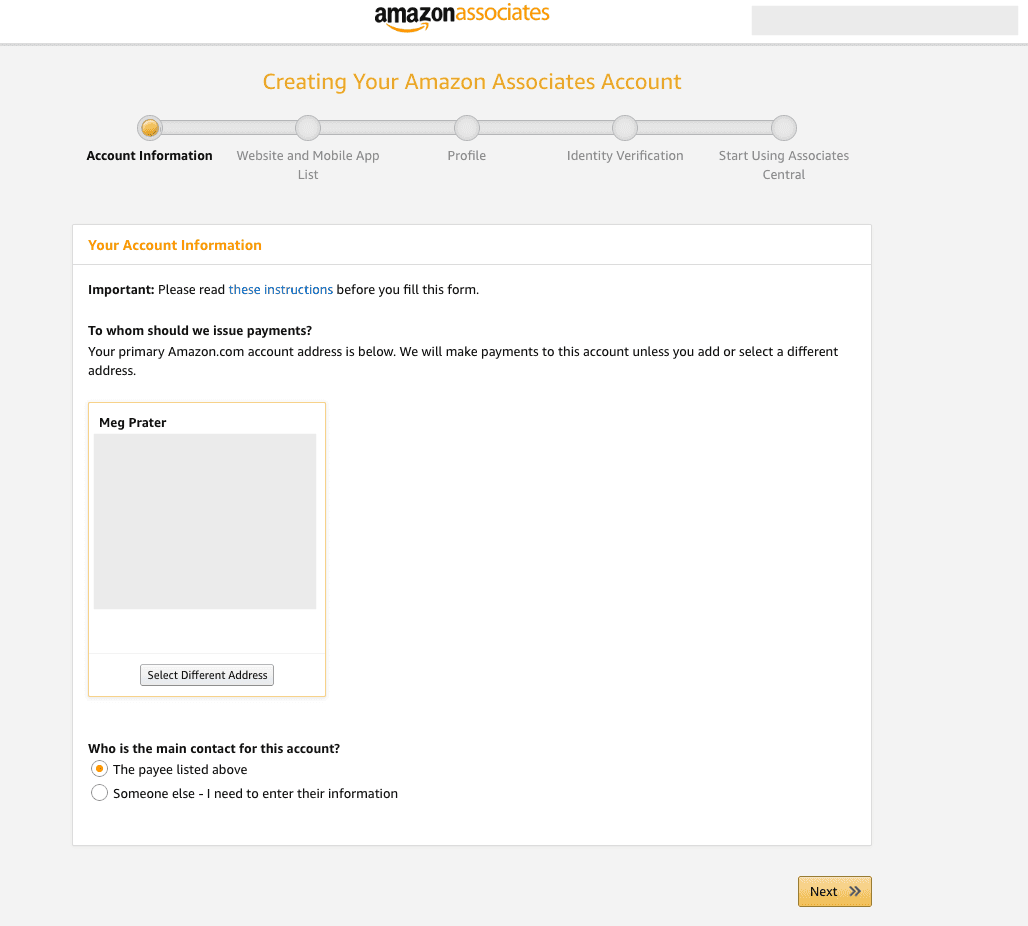
1. Enter your account information.

Enter your account info (including the name, address, phone number of the payee)
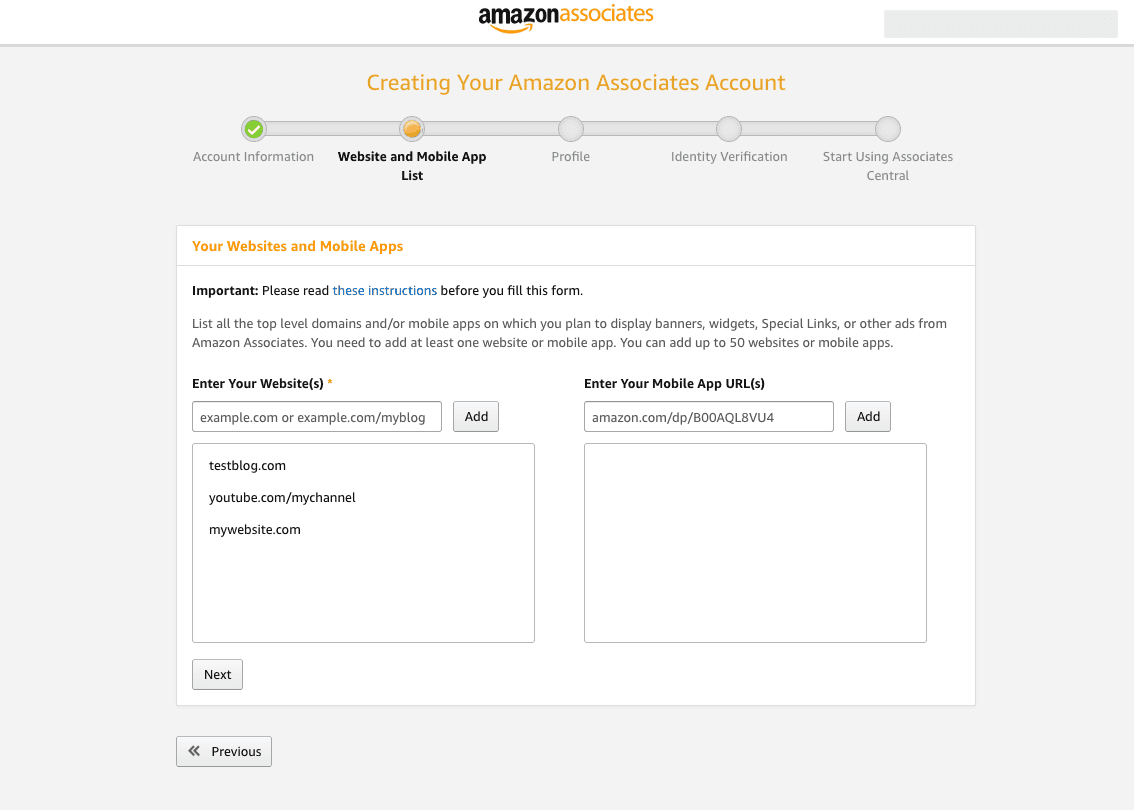
2. Enter your website address.

Enter your website address(es), apps, YouTube channels, etc.
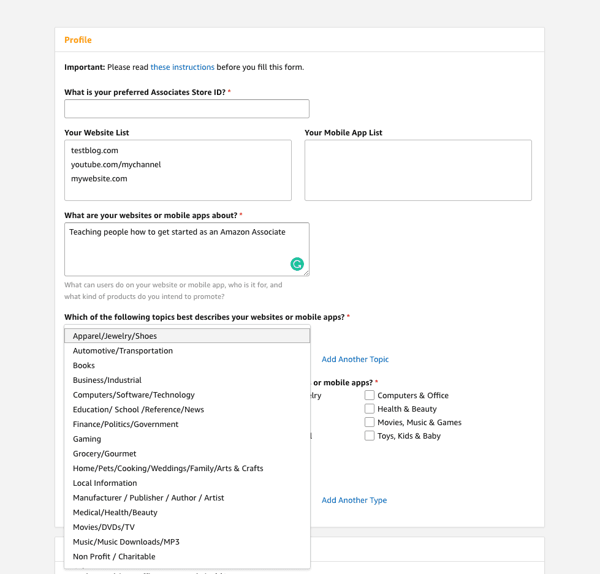
3. Enter your preferred store ID.

Enter your preferred store ID (usually the same as your primary website name), explain what your websites hope to accomplish, and select Amazon topics your links will likely target.
amazon-affiliate-3

4. Explain how you drive traffic to your site.

Explain how you drive traffic to your websites, how you use your website or apps to generate income, how you usually build links, and how many visitors your site brings in each month.

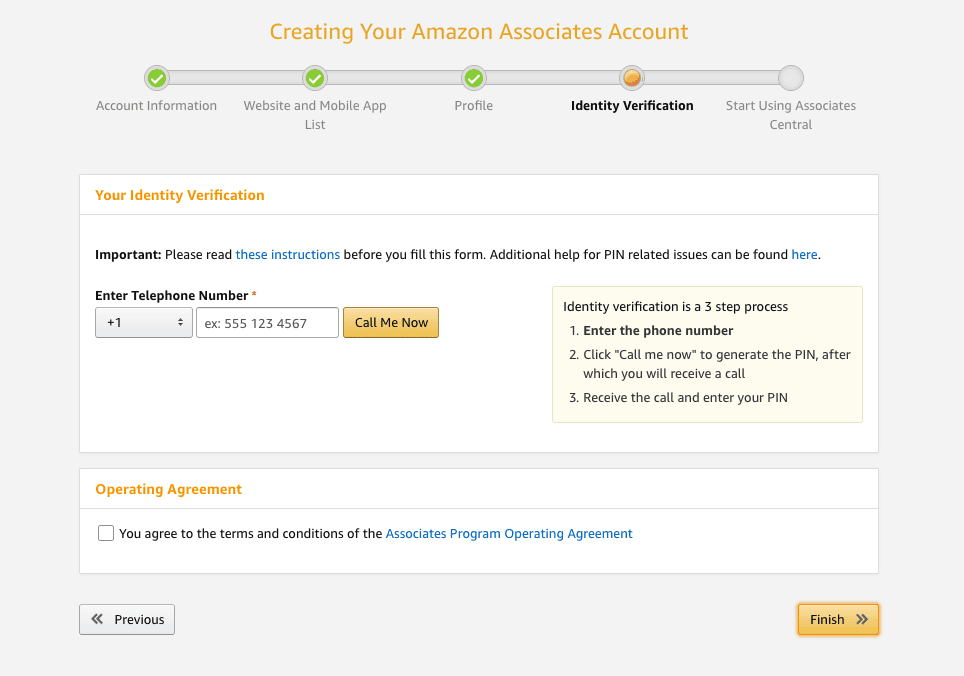
5. Enter your phone number.

Enter your phone number, press "Call Me Now," and wait for the immediate call from Amazon. They'll ask you to input a four-digit code, and once that is complete, your account will be approved.
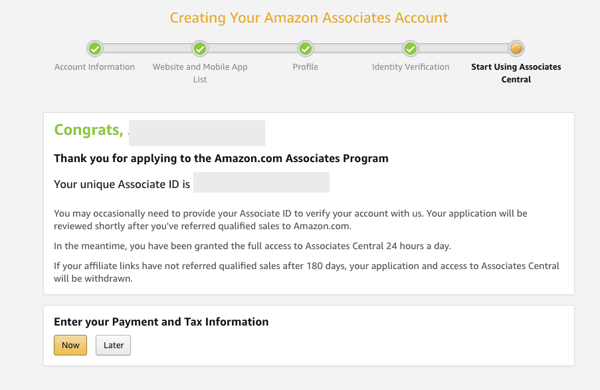
6. Choose your payment method.

Choose whether to enter your payment (credit card) and tax ID information in now or later. Then proceed to your dashboard.
amazon-affiliate-6

4. Create Amazon Affiliate links.

Once you've created your account, you'll be sent to your personal Associate homepage. This is where you'll find your performance dashboard (including an earnings overview, monthly summary, and total clicks).
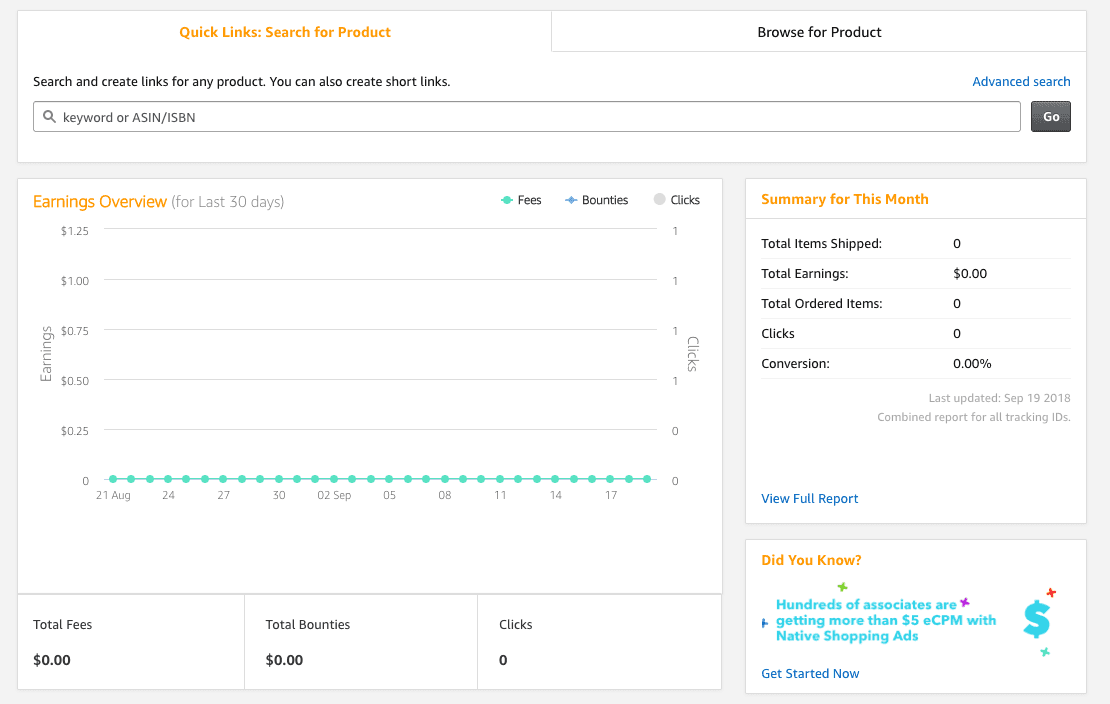
It's also where you'll search for relevant products to link to from your content. Here's how:
Your account will be approved for 180 days. During that time, you must make at least one sale, or your account will be closed. You can reapply for the Amazon Associate program after you've made certain adjustments to your site.
Are you ready to get started with the Amazon Associate Program? I hope guide helps. As with most marketing and sales, quality content is at the heart of success. Ensure you're attracting your audience with quality content and share relevant affiliate links with them on your site. Happy linking!

I Was Taking Turmeric Shots Daily For 1 Week, and this is How My Body Reacted to it

If you've spent any time online in the last year, you've heard about the wonders of turmeric. Derived from a plant called curcuma longa, turmeric is a yellow spice commonly used in Asian or Indian foods, and it's said to have many health benefits when taken regularly. Turmeric is anti-inflammatory, and it's said to improve digestion, relieve joint pain, and prevent heart disease.

There are all sorts of ways to get turmeric into your body, but I kept hearing that the best way is to make a tonic or take a shot of it. To be honest, juicing the turmeric root for the tonic sounded like a pain in the ass, so I decided to try homemade turmeric shots. After reading around online and asking various people who have had success with turmeric in the past, I decided my turmeric shots would include the following:
  • 1 tablespoon of ground turmeric
  • Freshly cracked black pepper (which is meant to help with absorption)
  • Freshly squeezed lemon juice from half a lemon
  • Coconut water
I also took a small spoonful of extra virgin coconut oil after the shot, because I heard this is also meant to help with absorption. I don't know how true that is, but I figured it couldn't hurt. This is what happened when I took my homemade shot every day for one week.
I Was a Pooping Machine
I didn't really feel much in the first couple of days, but about halfway into the week, I noticed a change in my digestion. I was suddenly running to the bathroom two or three times a day. I'm pretty regular as it is and I never have trouble relieving myself, so to see myself poop this much on the daily was a little alarming. The strange part was that my business was - sh*t's about to get real here - much runnier and more watery than usual. It felt like I was in the middle of a detox.
Nothing else in my lifestyle changed over this week, so I'm sure it was the turmeric working its magic. I'm still waiting for my bowel movements to return to normal again, and I'm wondering if my digestion will improve as my body gets used to the shots. Time will only tell.
I Could Barely Handle the Taste
I love cooking with turmeric, but this whole week may have turned me off of it for a while. Downing that shot was torture for me. Turmeric has a pretty potent taste, and I didn't like how it tasted with the pepper and coconut water together. Those flavors just do not mix if you ask me. I had to have something at arm's length to chew on right after I took the shot, like a spoonful of coconut yogurt or peanut butter toast. Just the taste alone is almost enough for me to never take those shots again.


I Definitely Had More Energy Than Usual
During the second half of the week, I woke up with a pep in my step every morning. I don't know if it was because I felt lighter from all the bathroom trips, but whatever it was, I had a lot of energy in the a.m. Turmeric is said to boost serotonin and dopamine in your brain, so this may have been why I had more energy and was in a better mood every morning.
The Soreness From My Workouts Went Away Faster
This was certainly the best part of my turmeric experiment. The anti-inflammatory benefits of turmeric helped me recover from my workouts even faster. I had a particularly difficult lower-body session at one point during the week, which left me pretty sore the next morning. But I noticed that this soreness faded away much quicker than usual. Rather than walking around for two whole days sore I only really noticed the soreness for one full day. It was like my muscles were building and getting stronger at a faster rate. How sci-fi!
My Stomach Hurt If I Didn't Take It With Food
I practice intermittent fasting, so I stop eating after 4 p.m. Two out of the seven days, I took my turmeric shot at night before bed (only because my lazy self forgot to in the morning), and I soon realized this was a mistake. I woke up with a tummy ache. It felt slightly like I was gassy, but it wasn't exactly the same sensation as having to fart. The feeling went away once I had a full meal. I can almost definitively say this was because I took it without food, though, because the mornings when I took my turmeric shots with breakfast, I didn't have that issue at all.
I'm not sure I'll continue taking these shots every single day. However, because I did see some good results, I would certainly consider another kind of tonic or drink that tasted better than this one. I'd like to see what happens to my body if I continue to take turmeric supplements every day. I have a feeling it would do wonders for my recovery time outside of the gym in the long run.


Try These 3 Things To Make You Focus At Work In An Open Office

  Workplace cubicles are fading into the past; no longer do they box in our creativity or compartmentalize our freedom. Now, we have the opportunity to work more closely with our peers. The knowledge-sharing economy has upended our traditional offices in major ways. Open floor plans, long shared tables and interactive tech tools are some of the most common features in work environments. The coworking model is meant to foster collaboration, engage learning and promote an active work culture. The trend is so popular that some startups even focus their business model on utilizing restaurants as coworking hubs during off hours. YOU SHOULD READ THIS!      Yet, coworking spaces come with their fair share of distractions. Several minutes of uninterrupted work time can be hard to come by, especially when you're constantly overhearing brainstorming sessions.  While open office spaces may nurture collaboration, a solution for better concentration from group activities may rely on collaboration itself. As concentration is greatly intertwined with privacy and performance, this solution focuses on three key components: office structure, individual tactics and group mentality.  Doorways to distraction Collaborative office spaces aren't going away anytime soon. Today, nearly 70 percent of U.S. companies feature open concept offices. But, the new office design hasn't gone without its fair share of critics. In January, the BBC reported that research indicates workers are 15 percent less productive and have immense trouble concentrating in open working spaces. In addition, University of Sydney professors found that 50 percent of people in open office floor plans were dissatisfied with their sound privacy. Other studies consistently demonstrate that over half of non-executive workers report feeling less satisfied and less productive in open space offices. In a recent survey, 58 percent of high-performing employeesreported needing more privacy for problem-solving. 54 percent found their environments too distracting. It's no wonder the open office is getting a negative rapport. Our sensitivity is not in vain either. Research demonstrates that a ringing phone can damage productivity, but small vibrations from tech devices significantly tax our brains. More worryingly, evidence shows that the mere presence of a phone weakens our concentration. Even with so many resources available today that can help us focus, organic and traditional principles that center around workers' individual mindsets and a business's operational structure may be the true solution: Managerial and organizational strategies One big step for better employee concentration at work is to improve managerial and organizational strategies. Part of a manager's responsibility is to help facilitate productive interaction, which can often mean facilitating periods of concentration. Managers can help organize office rules with five key steps: Create designated quiet areas. Even if there is limited space, creating small areas with available resources can help promote concentration in immediate environments. According to author and productivity consultant Laura Stack, using a free conference room or offering a makeshift library where your coworkers can retreat in lieu of remote work can help preserve their privacy. Schedule quiet times. Specifying quiet times can help individuals do their work during the day. Each week, designate a few quiet hours, when employees are encouraged to work individually. Focus on establishing a schedule at least twice a week for 2 to 3 hours in the morning or afternoon. Afterwards, employees can collaborate as needed. Encourage busy signals. A "busy" symbol will notify coworkers not to disturb the worker during optimal moments of concentration. Batch communications. Too many emails and demands from higher-ups create frustration and constant interruptions for workers. Good managers should consider batch updates and information in one email or quick meeting so that workers and managers are clearly communicating with each other, which ultimately help save time and any confusion about work activities. Personal strategies On a personal level, there are many ways to help embrace better concentration. Headphones are just the first step. Specific strategies depend on the type of task, the worker's mood, how they learn and individual personalities. For example, researcher Susan Cain's recently discovered that people who more readily identify as introverted are more sensitive to stimuli in their immediate environments. But, according to Harvard Business Review (HBR) research, humans employ several privacy strategies - consciously and subconsciously -- to help control the intake of stimulation and information during the workday, which aid in concentration. Shielding is a conscious privacy tactic that allows people to gain more privacy and control over their projects by maneuvering to enclosed locations. We use it all the time when take a phone call out of the office so we might not be overheard. According to HBR, developing a walking plan may help you concentrate and solve problems away from a distracting office. Also, you should try sitting in areas where you can't see coworkers approaching. There is also a psychological tactic, called "intentional shielding," which allows workers to guard their own judgment by protecting their individual thoughts to develop ideas rather than sharing them outright in brainstorming sessions at the risk of peer pressure. Seclusion is about purposefully separating from a group, allowing workers the time to reboot and concentrate. The action is frequently chosen when workers have the opportunity to use spare rooms or other closed spaces for visual or acoustical privacy to focus on a project. Anonymity is a purposeful tactic that is often used by workers that often allows them to concentrate in the middle of a crowd of strangers. Because they are anonymous, they can choose when and how to concentrate. They might set up in a crowded cafe or airport. Interestingly, research published in the Journal of Consumer Research found that working in environments with moderate levels of ambient noise can improve performance on creative tasks. Ambient activity and noise can be a strategic motivator for work when individuals choose to inhabit anonymous roles, where people are less likely to distract them directly. Group strategies YOU SHOULD READ THIS!    As a strategic process, collaboration demands both individual and group effort. Private time for focus is needed to generate ideas, process information and formulate strategies. Workers can then come together as a group to further develop a shared vision. Then, private time is further needed to focus individual tasks for the plan. If it's an especially demanding project, workers emphasize time periods of private work to think and recharge their thoughts. Concentration organization Concentration is work in itself. But, all's not lost on the concentration front. Coworking spaces can provide a sense of job control, allowing employees to change their workstation, when they work and who they associate with. Call it concentration organization or a redefining of privacy at work, but each worker will have a share in the workload of consolidating private time for better concentration. Everyone can benefit from a balancing the personal and team-oriented goals in the office. Maybe you will be able to manage those annoying emails from Dave a bit more easily.

Workplace cubicles are fading into the past; no longer do they box in our creativity or compartmentalize our freedom. Now, we have the opportunity to work more closely with our peers. The knowledge-sharing economy has upended our traditional offices in major ways. Open floor plans, long shared tables and interactive tech tools are some of the most common features in work environments.
The coworking model is meant to foster collaboration, engage learning and promote an active work culture. The trend is so popular that some startups even focus their business model on utilizing restaurants as coworking hubs during off hours.

YOU SHOULD READ THIS!


Yet, coworking spaces come with their fair share of distractions. Several minutes of uninterrupted work time can be hard to come by, especially when you're constantly overhearing brainstorming sessions. 
While open office spaces may nurture collaboration, a solution for better concentration from group activities may rely on collaboration itself. As concentration is greatly intertwined with privacy and performance, this solution focuses on three key components: office structure, individual tactics and group mentality. 

Doorways to distraction

Collaborative office spaces aren't going away anytime soon. Today, nearly 70 percent of U.S. companies feature open concept offices. But, the new office design hasn't gone without its fair share of critics. In January, the BBC reported that research indicates workers are 15 percent less productive and have immense trouble concentrating in open working spaces.
In addition, University of Sydney professors found that 50 percent of people in open office floor plans were dissatisfied with their sound privacy. Other studies consistently demonstrate that over half of non-executive workers report feeling less satisfied and less productive in open space offices. In a recent survey, 58 percent of high-performing employeesreported needing more privacy for problem-solving. 54 percent found their environments too distracting. It's no wonder the open office is getting a negative rapport.
Our sensitivity is not in vain either. Research demonstrates that a ringing phone can damage productivity, but small vibrations from tech devices significantly tax our brains. More worryingly, evidence shows that the mere presence of a phone weakens our concentration.
Even with so many resources available today that can help us focus, organic and traditional principles that center around workers' individual mindsets and a business's operational structure may be the true solution:

Managerial and organizational strategies

One big step for better employee concentration at work is to improve managerial and organizational strategies. Part of a manager's responsibility is to help facilitate productive interaction, which can often mean facilitating periods of concentration. Managers can help organize office rules with five key steps:
  • Create designated quiet areas. Even if there is limited space, creating small areas with available resources can help promote concentration in immediate environments. According to author and productivity consultant Laura Stack, using a free conference room or offering a makeshift library where your coworkers can retreat in lieu of remote work can help preserve their privacy.
  • Schedule quiet times. Specifying quiet times can help individuals do their work during the day. Each week, designate a few quiet hours, when employees are encouraged to work individually. Focus on establishing a schedule at least twice a week for 2 to 3 hours in the morning or afternoon. Afterwards, employees can collaborate as needed.
  • Encourage busy signals. A "busy" symbol will notify coworkers not to disturb the worker during optimal moments of concentration.
  • Batch communications. Too many emails and demands from higher-ups create frustration and constant interruptions for workers. Good managers should consider batch updates and information in one email or quick meeting so that workers and managers are clearly communicating with each other, which ultimately help save time and any confusion about work activities.

Personal strategies

On a personal level, there are many ways to help embrace better concentration. Headphones are just the first step. Specific strategies depend on the type of task, the worker's mood, how they learn and individual personalities. For example, researcher Susan Cain's recently discovered that people who more readily identify as introverted are more sensitive to stimuli in their immediate environments.
But, according to Harvard Business Review (HBR) research, humans employ several privacy strategies - consciously and subconsciously -- to help control the intake of stimulation and information during the workday, which aid in concentration.
  • Shielding is a conscious privacy tactic that allows people to gain more privacy and control over their projects by maneuvering to enclosed locations. We use it all the time when take a phone call out of the office so we might not be overheard. According to HBR, developing a walking plan may help you concentrate and solve problems away from a distracting office. Also, you should try sitting in areas where you can't see coworkers approaching.
    • There is also a psychological tactic, called "intentional shielding," which allows workers to guard their own judgment by protecting their individual thoughts to develop ideas rather than sharing them outright in brainstorming sessions at the risk of peer pressure.
  • Seclusion is about purposefully separating from a group, allowing workers the time to reboot and concentrate. The action is frequently chosen when workers have the opportunity to use spare rooms or other closed spaces for visual or acoustical privacy to focus on a project.
  • Anonymity is a purposeful tactic that is often used by workers that often allows them to concentrate in the middle of a crowd of strangers. Because they are anonymous, they can choose when and how to concentrate. They might set up in a crowded cafe or airport. Interestingly, research published in the Journal of Consumer Research found that working in environments with moderate levels of ambient noise can improve performance on creative tasks. Ambient activity and noise can be a strategic motivator for work when individuals choose to inhabit anonymous roles, where people are less likely to distract them directly.

Group strategies

YOU SHOULD READ THIS!


As a strategic process, collaboration demands both individual and group effort. Private time for focus is needed to generate ideas, process information and formulate strategies. Workers can then come together as a group to further develop a shared vision. Then, private time is further needed to focus individual tasks for the plan. If it's an especially demanding project, workers emphasize time periods of private work to think and recharge their thoughts.

Concentration organization

Concentration is work in itself. But, all's not lost on the concentration front. Coworking spaces can provide a sense of job control, allowing employees to change their workstation, when they work and who they associate with.
Call it concentration organization or a redefining of privacy at work, but each worker will have a share in the workload of consolidating private time for better concentration. Everyone can benefit from a balancing the personal and team-oriented goals in the office. Maybe you will be able to manage those annoying emails from Dave a bit more easily.


Stop Your Lazy Thinking With These 5 Tips and Start Making Great Decisions

The number of decisions we make and the complexity of the problems we solve sometimes exceeds the brain’s capacity. To respond faster and more efficiently to the multiple demands of daily life without having to reinvent the wheel, our brains streamline the decision-making process. How? By creating shortcuts. Called heuristics, these shortcuts actually are overlearned ways of choosing and using information. Heuristics help you make snap judgments. But what you save in time, you lose in accuracy. If your heuristics are flawed, your snap judgments will be, too.

Scientists have identified approximately 100 of these flawed heuristics and refer to them as cognitive biases. Unfortunately, these biases lead to haphazard fact-finding, shallow processing and hasty conclusions. They make you believe things that aren’t true and ignore things that are. Essentially, they're turning you into a lazy thinker.


Your biases and lazy thinking can have profound effects on the decisions you make, the actions you take and the results you obtain. You can train train yourself to avoid five of the most common cognitive biases. Here's how.


1. Question your beliefs.
When you accept ideas as logical and true because they sound believable, you commit belief bias. The more consistent with your beliefs an idea sounds, the less likely you are to look for proof. Strong, unchallenged beliefs determine which actions you will or won’t take to achieve your goals. For example, if you believe that most small businesses fail, you're unlikely to start one of your own. If you believe your product isn't worth paying for, you'll never make it available for sale. And if you believe your message isn't powerful or important enough, you'll never share it.
Ask: Which facts support your own beliefs?


2. Look for facts that disprove your point.
We like to be right. And to protect our desire to be right, we search for evidence that supports our ideas and ignore evidence that contradicts them. This is confirmation bias, and while it's a more scientific way of thinking than belief bias, it's still cheating. Your biased sampling makes you think you are right even when you are wrong. If you think your new assistant is incompetent, you'll keep looking for mistakes and problems. When performance-evaluation time rolls around, your data is a laundry list of shortcomings. So of course you believe you were right all along. Being willing to collect evidence that disproves your point not only helps you anticipate problems but also makes your point stronger.

Ask: What evidence are you collecting to disprove your point?


3. Estimate the odds of success.
Everyone can rattle off a factoid or two, but few people fully comprehend statistics -- and even fewer use them to make decisions. When you choose your course based on a specific event without considering that event's true probability, you're showing another bias: base rate neglect. Base rate is how often something occurs in a population, such as divorce rates, crime rates and college graduation rates.

Base rate neglect sidetracks you with glowing testimonials and makes you forget about what is statistically possible. If you're thinking about starting your own business but want to get an MBA first, it would help you to know the percentage of successful small-business owners who have an MBA. In a similar vein, if you were tempted to register for a program that promises to make you a millionaire, you'd want to research further than the quotes on the group's website.

Ask: What else do I need to know?


4. Consider you might be wrong.
Did you know ahead of time which team would win the World Series last year? How about which movie would get the Oscar? Which stocks would plummet in January? If you said yes to any of these questions, you're demonstrating hindsight bias. You claim you knew what was going to happen, but you make that claim after the event already has occurred. What's more, you believe it.

Hindsight bias gets even more twisted. Research shows people misremember their own predictions.

Let’s play for a moment: Without consulting Google or Siri or Cortana, do you know how old Mother Teresa was when she died? Take a guess and say the answer to yourself. If I called you a month from now to follow up, many of you would say you chose a number much closer to the correct answer than the true age you whispered just now. The most serious problem with hindsight bias is you fail to learn from your mistakes. And it's understandable, since this bias makes you forget you made any.


Ask: What have you been wrong about in the past?


5. Learn when to follow emotion and when to ignore it.
Could you make good decisions without your emotions? Probably, but in some cases it would require more work and take a lot longer. Emotions send quick, straightforward messages to the decision-making part of the brain, which in turn determines what to do with all that information. When emotion-laden messages are too loud, they influence your decisions. That's visceral bias.

Your feelings in the moment can distort your objectivity and influence how you judge a person or a situation. Positive emotions could make you overestimate your abilities, underestimate the risks, exaggerate potential gains and shift your priorities. Things that make us feel good seem more important, necessary or valuable. People who make us feel good seem more helpful and genuine. On the flip side, negative emotions could make you underestimate your abilities, overestimate the risks, exaggerate the consequences and ignore your priorities. We judge things that make us feel bad as unimportant, unnecessary or worthless.


How To Be The Best Networker With This 16 Tips


The whole process of “professional development” can be quite complex and intimidating. For introverts and newbies without professional connections, it can feel downright unfair.
But, as the old saying goes, “it’s not what you know; it’s who you know.” Networking can be your key to success -- granting you access to a host of opportunities with jobs, investors and even customers. And, thanks to a host of advances in technology, the playing field has been leveled. Anyone can build connections and grow their network, so long as they invest enough time and resources in the right strategies.
There is no recipe that will guarantee you success in developing your network. You are far more likely to want to give up because of all your failures throughout the process. But as long as you keep the right attitude and expectations, you are certain to learn something (about both yourself and others). 
I’ve put together 16 tips to help you become a master networker. These are some of my favorite tidbits of advice I have picked up over the years, and they’ve greatly changed the way I go about meeting new people.

1. Be yourself.

Before I dive into any tactical strategies, I have to say this: there is a virus going around the professional world today, and it is rooted in fake and superficial behavior. Everyone is putting on a facade, trying to be the person they think other people will like.
What they do not realize is that what everyone really wants to see, whether they are on LinkedIn or at a conference, is real people. Human beings enjoy talking to other human beings, not spammy advertisements or built-up personas. We want real, living people.

2. Be direct and honest.

On the same note, a lot of people seem to believe that to be a good networker, you have to impress everyone else in the room. While you do want to be memorable, lying to get there is not the best strategy. It is generally easy to spot a liar.
And even if people do not catch you at first, sooner or later some smart person will expose your falsehoods to the rest of your network, forever tarnishing your brand and reputation. It can be absolutely devastating.

3. Build relationships.

Often, professionals make networking seem transactional. The reality, however, is that building your network is about interacting with other humans. It is relationship based, not a sales product. You are not trying to sell these people anything (especially not the first time you meet them). Remember that you want these people to like you, not buy a car from you.

4. Meet in person.

Establishing connections via email is one thing, but actually getting together face to face takes the relationship to a different level. Take advantage of networking meetups or events to get to know people. These offer opportunities to quickly grow the number of deep connections you have in a short amount of time simply by sitting down for coffee with new people.

5. Show up early.

If you are attending a networking event, spend the extra 5 minutes and get there early. This does 2 things. First, it shows that you care. People who are prompt demonstrate that they are prioritizing whatever it is they are showing up to. Second, it indicates that you are organized. No one wants to do business with someone who is sloppy -- prompt people have their schedules under control.

6. Provide value for free.

Once you’ve ditched the cheesy sales pitch, realize that everyone online and at these events is selfishly looking for things that further their own careers and companies. And there is nothing that these people want more than free resources! So start providing others with value, for free.
It does not have to be anything massive, and might be simply a strategic recommendation or tidbit of advice. Investing just 5 minutes of your time to help someone else could pay dividends in the long term.

7. Take notes.

After meeting someone (either in person or on the phone), jot down a few notes. Try to  remember small details that the other person shared with you. Remembering simple things like what they like to eat or where they like to travel can become important bits to use in later interactions.

8. Follow up.

Another great way to show that you care about the people you meet is to send a simple follow-up email. Using any notes or pieces of information that you remember, write an email that includes your appreciation for what they had to say and perhaps ask a follow-up question.

9. Have specific questions.

People cannot help you if you don’t really know what you want. These are the worst type of networkers -- the people who only ask general questions without much substance. Come with a specific, concise question and you’ll find people are 10 times more likely to help you out.

10. Have fun.

Don’t forget to smile! Far too many of my friends have gone all in on their work, forgetting about what is really important to them.
If you are not having fun in the process, and building relationships with people you actually enjoy spending time with, then perhaps you are going about this in the wrong way. People like to hang out with people who are smiling and having fun. Just try it -- a smile doesn’t cost you anything!

11. Be memorable.

Many of us go overboard in trying to impress others because we think that is the best way to be remembered. While that technique sometimes works, far more often it is easier to be memorable than impressive.
Being different is actually far more achievable than being the very best. Try to think of ways that you and your brand separate yourself from the crowd -- like interesting stories or unique experiences.

12. Become a connector.

An easy way to provide value to others for free is to become a super-connector. Once you’ve begun building out your brand, you’ll find you know lots of people who would benefit from simply talking with each other. Spend the two minutes it takes to write an introduction email, and you have just made two people’s days! This will pay off in the long run.

13. Don’t spread yourself too thin.

Optimize for quality, not quantity. With the right software and strategy, it is fairly easy to throw your name out there and establish hundreds of surface-level connections. What is far more challenging, and more valuable in the long term, is establishing a few dozen close friends who you can rely on for big favors and help. You’ll find these deeper contacts to be more helpful when you need them -- the types of relationships that actually change lives.

14. Do an audit.

Every few weeks, you should do an internal audit of your time/network to see if you are surrounding yourself with the types of people who are (a) making you a better person and (b) challenging you in the right ways. It can be tough, but thinking about who you spend your time with to ensure you are on the right path is often extremely helpful.

15. Always remember where you started.

Months from now, when you have gotten your dream job and built out a massive network, remember where you started. When you are standing on a stage talking to thousands of people, remember that not too long ago you were one of those people.
Just because people do not have the fancy titles or recommended experience does not mean they are not worth talking to. Take bold bets on people out of a spirit of friendly helpfulness, and you’ll find yourself paying it forward.

16. Set realistic expectations.

If you really want to get your name out there, prepare to fail a lot and be ready to rebound. You will write tons of content that you think will go viral -- but none of it will. You will pay lots of money to go to events and walk away with no value. That is the nature of the beast. If it were easy to build out a big network, everyone would do it. But it isn’t -- it’s a long-term game that you will have to compete in.


What Treat Your Hair Need Immediately After a Workout


When you work out, sweat seeps into your hair, and can make it look greasy and dirty. That's no big deal when you're headed home for the evening. If your day isn't over yet, find ways to make your locks look fresh. A shower and shampoo is the best post-workout cleanup, but you can wipe away the sweat without lathering up. Dry shampoo, astringent hair tonics and a blow dryer help to degrease your tresses without the suds.

Step 1

Rinse your hair under warm water if you have time to shampoo in the shower. Lather a nickel-sized amount of shampoo between your hands, then massage it into your hair from the roots to the ends. Pay particular attention to areas where sweat collects, such as around your hairline and at the nape of your neck. Rinse thoroughly.

Step 2

Spritz your hair with an astringent hair tonic if you have time to shower but don't want to get your locks wet. Allow the steam and heat in the shower to help the tonic penetrate your hair, without the need for rinsing. The tonic works by breaking down excess sebum and sweat without water. Opt for a tonic that contains peppermint or tea tree oil -- they're potent astringents that also have a nice scent. Once you're done in the shower, blow-dry your hair until it's completely dry, then curl, iron or style as usual.

Step 3

Spray your hair with a dry shampoo if you can't get in the shower. Shake a can of dry shampoo a few times, then hold it about 10 inches away from your head. Slowly move the can back and forth as you spray the shampoo on the roots. Don't use too much product in one spot; if you see a buildup of white powder, you've used too much. Wait a few minutes, then brush the powder through your hair to help it soak up oil and dirt from your scalp. Check for remaining white residue and brush it out. If any spots still feel oily, add a bit more shampoo and brush it in.

Step 4

Use a blow dryer to refresh your hair if you can't shampoo. After working out, direct the warm air at the nape of your neck, then move it around your hairline for three to five minutes to dry up sweat. Rub a few drops of silicone styling serum or cream into the hair that frames your face, then aim the warm air at those strands to ease frizz and give hair luster.


RECENT POSTS

ad