ad

Showing posts with label Food. Show all posts

Food Tech Startup That's Way More Than Meat Is Rolling Out a Plant-Based Sausage


Plant-based protein company Beyond Meat is continuing its march down the meat aisle.

The El Segundo, Calif.-based startup is beginning the roll out of its plant-based sausage product—dubbed Beyond Sausage—with its launch today at a restaurant in a Boulder, Colo. Whole Foods. The next stage in its distribution will be announced in January, the company says.

Beyond Meat started working on its sausage product a year ago, but CEO Ethan Brown says the new item actually “captures the work that’s been going on for the previous nine years.”

“This is part of the continuum for us,” Brown. “It’s really been a mantra for us that we want to relentlessly and rapidly innovate.”

Beyond Meat is best known for its plant-based burger, and Brown says the company decided to go after a pork sausage next because of what he sees as consumers’ health concerns about processed meat. Products like hamburger and sausage are also easier to mimic because they’re ground, so the company doesn’t need to imitate the complex structure of, say, a sirloin or a chop.

“We just always want our product to be indistinguishable,” Brown says. “This is one I felt we could get closer to the animal equivalent than other categories.”

Beyond Meat is part of a growing cadre of startups that are attempting to make meat without animals to answer concerns about animal welfare, the environment, and health.

While plant-based alternatives have been around for decades, a cohort of this new generation of companies—including Beyond Meat—is using food tech to get plants to more closely replicate the taste and texture of animal protein.

To attract non-vegans and –vegetarians, Beyond Meat’s burger product is sold in the meat case of mainstream supermarkets like Kroger (KR). “We try to create products for people who eat meat,” explains Brown.

He says that one of the biggest challenges in creating a plant-based sausage was its varied bite. A sausage isn’t homogenous, Brown explains, since it’s made up of the different parts of muscle and fat within the animal. To recreate the sausage texture, the R&D team used a mixture of peas, fava beans, and rice. The Beyond Sausage also contains beet, paprika, and coconut oil.

Another head-scratcher for Beyond Meat’s scientists was how to replicate a sausage’s casing, which is usually made of animal intestine. It naturally folds back on itself—a quality that gives sausages their curved shape, Brown explains. It’s also semi-permeable, allowing some, but not all, of the fat to be released when cooking. “It’s an amazing material,” he adds.

As a solution, the Beyond Meat team decided to use alginate, a substance contained within algae. Brown says it’s decent but not perfect yet. To recreate the sausage’s curve, the company is going to sell the product in molded trays.

Beyond Meat will serve the sausage in three flavors: bratwurst, sweet Italian, and hot Italian. The product has no cholesterol and has 43% less total fat, 38% less saturated fat, and 26% less sodium than the animal-based equivalent.

Earlier this month, the startup announced that it had closed another round of funding from investors including Tyson Foods (TSN) and Cleveland Avenue. The company plans to use the money to expand its product portfolio and distribution.

6 Important Foods Specially Created Healthier Vagina


You are what you eat, and apparently, so is your vagina. Given that your diet affects pretty much everything from your menstrual cycle to your mood, it's no surprise that it can affect how things are going in your nether regions.
Here are a few tips from experts to keep everything down there working as it should.
1. Eat plenty of prebiotics and probiotics.
According to Jennie Ann Freiman, M.D., your vagina, like your gut, requires healthy bacteria to fight infections and maintain a normal pH. The bacteria in the gut, in turn, affects those in the vagina. To improve your gut health and your vaginal health, she advises eating prebiotic foods like garlic, onions, and raw leeks and probiotic foods like yogurt, kimchi, pickles, sauerkraut, tempeh, and kombucha tea. According to Brian A. Levine, M.D., consuming probiotics has actually been shown to help women with vaginitis—chronic vaginal discomfort that can lead to pain during sex. Prebiotic and probiotic supplements aren't great substitutes for these foods, Freiman says: "Lab formulations don't beat Mother Nature."
2. Enjoy nuts and other healthy fats.
Healthy fats like those found in nuts, olive oil, and avocados regulate your cholesterol, keeping your estrogen levels in balance, which in turn creates a healthy mucosal lining that can help ward off infection. Almonds and other types of nuts are especially good, says Levine, because they contain B vitamins and calcium that prevent vaginitis.
3. Avoid processed foods.
While prebiotic and probiotic foods add helpful bacteria to the gut and vagina, Freiman says processed foods depress your immune system, which can allow harmful bacteria to take over. This can lead to all sorts of problems down there, including bacterial vaginosis, yeast infections, dryness, pain during sex, and urinary tract infections.
4. Go easy on the sugar.
According to Burt Webb, M.D., too much sugar can damage or kill the important vaginal bacteria Lactobacilli, which can lead to yeast infections, soreness, and irritation—three things you really don't want to deal with.
5. Try to avoid artificial hormones.
Certain meats and dairy products contain xenoestrogens—artificial hormones that imitate estrogen. According to Webb, these can block estrogen from the vagina, preventing the mucosal lining from forming which again, can leave you open to infection.
6. Stay hydrated.
"The vagina is just like the inside of the mouth—when a woman is thirsty and parched, her vagina probably is too," says Levine. Hydration can also help prevent any unusual odors from surfacing down there, says Octavia Cannon, D.O.—just one more reason to gulp down those eight glasses a day.


Alter Your Mood and Be Happy With These Scientifically Proven Foods


Pretty much the only thing we have in common with Christian Grey is a preference for exercising control in all things—that and an appreciation for Edward Ruscha—which is why the idea of using food to change your mood sounds so scientific and Übermensch-y (Überfrauen-y?) and just plain cool.


Propellerads


In the pursuit of self-improvement and, you know, feeling better, we've assembled a list of healthy-ish foods and their emotional effects below. Seek bad-day bonbons elsewhere—though there are definitely times when those work too. For when everything is definitely not awesome
Mashed potatoes
Spuds contain the chemical chromium, which raises the brain's serotonin levels. (Serotonin = happy-making.)
Avocado
Besides being creamy and ridiculously tasty, avocado is a good source of fatigue-reducing folate, aka folic acid.
Almonds
There's a reason why magnesium, which these nuts have in spades, has been used to treat depression for 100 years. The omega-3 essential fatty acids in walnuts will do the trick too.

For when you're this close to breaking something/someone's face

Watermelon
The answer here is potassium, a mineral that helps keep blood pressure capped. (Bonus: The dietary fiber buys you some alone time in the bathroom, if you know what I mean.)
Oranges
Vitamin C has been proven to help people handle stressful situations, such as math tests and public speaking, better. Their tough skins mean they won't get smushed in your purse either and make everything even worse. Similar options: blueberries, strawberries, pretty much any berry.
Asparagus
Calming Vitamin B will keep you cool enough to plot your next move/revenge.
KiwisWeird, right? It's that serotonin again, which has been shown in studies to improve sleep quality and duration. 
Cereal
Grains trigger insulin production, which raises your blood sugar naturally. Also try: oatmeal, jasmine rice, whole-grain bread.
(Night) Cheese
Follow Liz Lemon's lead and have a few ounces of cheddar before bed: Calcium helps the brain use the tryptophan found in dairy to manufacture sleep-inducing melatonin.


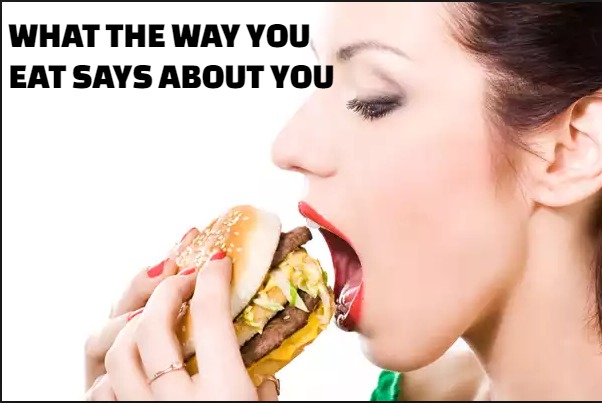
How You Eat Your Food Explains Who You Are.


If you believe a certain strain of science and psychology, we never do anything just to do it. There's meaning behind pretty much everything, including the mundane stuff like, oh, how we eat dinner. There's an amazing nine different ways of chowing down, and each connects to certain personality traits you likely see come out in other aspects of your life. The topic got a close look by the folks over at Little Things and they broke it down, bite by bite.


The slow eater:
You're the type who takes her time, wholeheartedly believing in the idea that it's quality over speed. You live in the present, and you really enjoy everything around you.
The fast eater:
Multitasking is your middle name. Hitting deadlines early is normal, and you're fairly competitive. There's a possibility you put the needs of others before yours, making it important that you take time for yourself.
The organizer:
You know those people who want everything on the dinner plate to remain in respective areas, free from any risk of cross-contamination? They're likely to be tidy and organized IRL too, with a tendency to be a bit inflexible.
The adventurer:
Approaching eating with a boldness that means you'll try everything translates into every aspect of your life. You're a brave risk-taker and never afraid of suggesting a new idea or plan.
The picky eater:
This is the person who loves being in her comfort zone and knowing exactly what's going on. You're curious, not afraid of asking questions, and love learning new things.
The isolationist:
It's the detail-oriented person who eats in this manner, finishing one type of food before moving on to the next. You're cautious, think everything through, and know there's a method to your madness. It's cool but essential to realize that others might not always see things the way you do.


The mixer:
If you mix everything on your plate together before eating, you're likely to be outgoing, friendly, and capable of taking on a lot. It's definitely true, but that means you also run the risk of overextending yourself.
The oversharer:
People eating dinner with you know what's going on: They hear you crunching, munching, and generally enjoying yourself. The unabashed spirit shows that you don't care what others think and are comfortable with presenting yourself exactly as you are.
The preparer:

Carefully cutting up your food and getting it perfectly ready means you tend to be forward-thinking, ambitious in your professional goals, and always eager to nail down plans and future dates with friends and family.


Burger Kings Admits They Are Using Horse Meat In The Burgers


The United States Food and Drug Administration has report that during inspection of Wendy’s famous Rich & Meaty Chili, traces of equine and rattus DNA strains were found. Wendy’s Chief Executive Director Boris Washington, immediately admitted that horse and rat had been used in the chili as a beef supplement.


“We only use about 30% beef, the rest is made of meat fillers, rat and horse meat. Using this type of meat is a cheaper expense for us, allowing us to competitively price our food while been profitable at the same time. What we are doing is not illegal or unhealthy. The FDA has approved the contents of the meat. We will continue with our business plan” explains Washington. Horse and rat meat has been used as a delicacy in some countries like China and South Africa, however it is taboo in the United States. Many people consider horses as pets and the consumption of horse meat is along the likes of consuming dog meat which is looked down upon by most Americans. Rats are rodents and its consumption is even more frowned upon.
Burger King has faced allegations of orchestrating a cover-up of its links to the horsemeat scandal in order to give it time to find an alternative supplier.
It is currently shipping in tens of thousands of burgers from suppliers in Germany and Italy in order to meet demand at its UK outlets.
It is known that the management at Silvercrest has been using a series of non-approved ingredients in their burgers for a range of household name brands.
These included meat off-cuts, including horse, that were imported in large frozen blocks from Poland.
The contamination has been going on since at least last May and potentially for up to one year, according to evidence presented to MPs earlier this week.
As announced by Burger King on this subject:
“We discovered that Silvercrest is using small percent of beef originating from non-approved Polish suppliers, who promised to supply them with 100% British and Irish beef cutlets.
They did not fulfill their promise.
All of this is completely against our rules and regulations, so we decided to end up the partnership with this supplier.
As we`ve confirmed, this Polish supplier is the source of the contaminated meat that came from Silvercrest.”

RECENT POSTS

ad