ad

Showing posts with label Isis. Show all posts

An American Woman Has Been Accused Of Using Bitcoin to Send Money to Islamic State


A woman from New York City has been accused of stealing and laundering over $85,000 to send to Islamic State, using Bitcoin and other cryptocurrencies, said the Department of Justice on Thursday.

The DOJ identified the woman as 27-year-old Zoobia Shahnaz, who was born in Pakistan and worked as a lab technician in the U.S. Shahnaz was charged with bank fraud, conspiracy to commit money laundering and three counts of money laundering. She is currently being held without bail.


“The defendant defrauded numerous financial institutions and obtained over $85,000 in illicit proceeds, which she converted to Bitcoin and other cryptocurrencies,” the DOJ explained in a statement. “She then laundered and transferred the funds out of the country to support the Islamic State of Iraq and al-Sham (“ISIS”) … After consummating the scheme, the defendant attempted to leave the United States and travel to Syria. Shahnaz, a U.S. citizen, was arrested yesterday.”

Shahnaz allegedly obtained the funds by falsely representing herself and tricking banks into giving her a $22,500 loan and over a dozen credit cards. She then used these to buy around $62,000 in cryptocurrencies online, according to the district attorney’s office. After obtaining the digital dollars, she wired them to individuals and shell corporations in Pakistan, China and Turkey that were destined for the terrorist organization ISIS.

According to the BBC, prosecutors said Shahnaz got a Pakistani passport in July and attempted to board a flight at New York City’s John F. Kennedy Airport for Pakistan on July 31, with a layover in Turkey. She was arrested at JFK airport because officials said her itinerary was suspect and prosecutors believed she was trying to leave the U.S. for Syria to join ISIS, according to the DOJ statement.

“Her itinerary included a multi-day layover in Istanbul, Turkey – a common point of entry for individuals traveling from Western countries to join ISIS in Syria,” the DOJ document stated. “The defendant’s return ticket had been booked for September 4, 2017 on a Turkish Airlines flight from Istanbul to JFK.”

The BBC says Ms Shahnaz faces up to 20 years in prison on each of the money laundering charges and up to 30 years for the bank fraud charge.

Her lawyer, Steve Zissou, claims she was sending money overseas to help Syrian refugees, reported the BBC.

“What she saw made her devoted to lessening the suffering of a lot of the Syrian refugees and everything she does is for that purpose,” Mr Zissou said outside the courthouse, to the BBC.


UK pharmacist Sent To Prison for showing ISIS beheading video to schoolchildren


A UK pharmacist is behind bars for trying to radicalize two elementary school-aged students and showing one of them a video of an American soldier being beheaded.

Zameer Ghumra was sentenced to six years in prison Friday for disseminating terrorist propaganda while trying to brainwash two young brothers into becoming Islamic State fighters.

The 38-year-old worked as a pharmacist in Northamptonshire, England and was trying to set up a madrasa, an Islamic school, when he taught the two boys how to survive a bomb attack and fight with knives, The Guardian reported.

“[Ghumra] had ISIS training videos and people being beheaded,” one of the boys reportedly told the court. “There was talking and then the American soldier was beheaded.”

He added: “It made me feel disgusting. He said, ‘If you truly love Allah, then you do it.’ I told him I get a horrid feeling when I see this.”

The boys’ ages were not revealed.

The boys' mother told the court that Ghumra told her son that kafirs, non-believers, “go to hell, even if they’re good people,” The Guardian reported.

TRENDING CONTENTS


“He said if you truly believe in God you do it for him. He said they would go to Turkey and make a run for it.”

Additionally, Ghumra followed various ISIS-linked social media accounts and had online conversations with Anjem Choudary, a jailed radical preacher. He reportedly told the two boys that Choudary was a good man.

“These were shocking crimes which damaged the children and caused offense to the vast majority of law-abiding Muslims,” said judge Gregory Dickinson QC, who added that Ghumra showed an “absence of remorse.”

Ghumra was arrested at Birmingham airport in September 2015. At his home, police seized a computer showing 1,600 search results for terms including “survival knives” and “bushcraft.”

A phone containing a video of the training nor the video itself were recovered, police said.

“Zameer Ghumra tried to brainwash impressionable children with this violent ideology by making one watch beheading videos and urging them both to adopt a hardline religious outlook,” Sue Hemming, of the Crown Prosecution Service (CPS) said.

“The CPS case was that he intended to radicalize them in the hope that they would go on to be involved in terrorism. The children were brave to give evidence and we would like to thank them for helping to secure this conviction of a dangerous man.”


Bomb Explosion At an Egyptian Christian cathedral kills 25


A bombing at a chapel adjacent to Egypt's main Coptic Christian cathedral killed 25 people and wounded another 49 during Sunday Mass, one of the deadliest attacks carried out against the religious minority in recent memory and a grim reminder of Egypt's difficult struggle to restore security and stability after nearly six years of turmoil.


The attack came two days after a bomb elsewhere in Cairo killed six policemen, an assault claimed by a shadowy group that authorities say is linked to the outlawed Muslim Brotherhood. That group — called "Hasm," or "Decisiveness" — distanced itself from the attack in a statement issued Sunday night, saying it does not as a principle kill women, children, the elderly or worshippers.


The statement, at least in theory, leaves the extremist Islamic State group or like-minded independent militants as the chief suspects.

There was no immediate claim of responsibility for Sunday's attack. However, Islamic militants have targeted Christians in the past, including a New Year's Day bombing at a church in the Mediterranean city of Alexandria in 2011 that killed at least 21 people. More recently, churches and Christian property in southern Egypt were targeted in the aftermath of the military's July 2013 ouster of an Islamist president. Those were blamed on Brotherhood supporters and ultraorthodox Salafi Muslims.


Read The Unthinkable Things ISIS is Doing With Sex Slaves in Their Territories

STORY FROM THE ASSOCIATE PRESS .

The advertisement is as chilling as it is incongruous: a girl for sale is "Virgin. Beautiful. 12 years old...Her price has reached $12,500 and she will be sold soon."


The posting in Arabic appeared on an encrypted conversation on a smart phone app, along with ads for kittens, weapons, and tactical gear. It was shared with the Associated Press by an activist with the minority Yazidi community, whose women and children are being held as sex slaves by the extremists, who view the Yazidis as barely human. The Yazidi faith combines elements of Islam, Christianity, and Zoroastrianism, an ancient Persian religion. Their pre-war population in Iraq was estimated around 500,000. Their number today is unknown.
While the Islamic State group, known in Arabic as Daesh, is losing territory in its self-styled caliphate, it is tightening its grip on the estimated 3,000 women and girls held as sex slaves. In a fusion of ancient barbaric practices and modern technology, Daesh fighters sell the women like chattel on smart phone apps and share databases that contain their photographs and the names of their "owners" to prevent their escape through IS checkpoints. The fighters are assassinating smugglers who rescue the captives, just as funds to buy the women out of slavery are drying up.

The thousands of Yazidi women and children were taken prisoner in August 2014, when Daesh fighters overran their villages in northern Iraq with the aim to eliminate the Kurdish-speaking minority because of its ancient faith. Since then, Arab and Kurdish smugglers have managed to free an average of 134 people a month. But by May, a crackdown reduced those numbers to just 39 in the last six weeks, according to figures provided by the Kurdistan regional government.

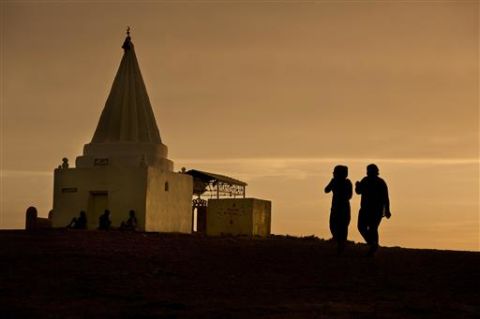
The sun sets as women visit a Yazidi shrine overlooking at Kankhe Camp for the internally displaced in Dahuk, northern Iraq.
Mirza Danai, founder of the German-Iraqi aid organization Luftbrucke Irak, said in the last two or three months, escape has become more difficult and dangerous. "They register every slave, every person under their owner, and therefore if she escapes, every Daesh control or checkpoint, or security force, they know that this girl...has escaped from this owner," he said.
U.S. State Department spokesman John Kirby told the AP that the U.S. continues "to be appalled by credible reports that Daesh is trafficking in human beings, and sex slavery in particular." "This depravity not only speaks to the degree to which Daesh cheapens life and repudiates the Islamic faith, it also strengthens our resolve to defeat them," he said.

A land mine exploded, killing her companions, 8-year-old Almas and Katherine, 20. She never learned their last names. The explosion left Lamiya (pictured above) blind in her right eye, her face scarred by melted skin. Saved by the man who smuggled her out, she counts herself among the lucky.
"Thanks to God, I managed to get away from those infidels," the 18-year-told the AP from a bed at her uncle's home in the northern Iraqi town of Baadre. "Even if I had lost both eyes, it would have been worth it, because I have survived them."
Nadia Mourad, an escapee, has appeared before the U.S. Congress and the European Parliament to appeal for international help. "Daesh is proud of what it's done to the Yazidis," she said to Parliament. "They are being used as human shields. They are not allowed to escape or flee. Probably they will be assassinated. Where is the world in all this? Where is humanity?"
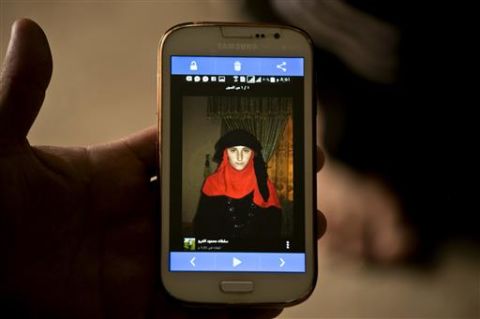
The AP has obtained a batch of 48 head shots of the captives, smuggled out of the IS-controlled region by an escapee, which people familiar with them say are similar to those in the extremists' slave database and the smartphone apps.


Islamic State group militants took this photo of Yazidi girl Nazdar Murat, as part of a database the militants have put together of Yazidi girls and women they have enslaved.

In addition to the posting for the 12-year-old in a group with hundreds of members, the AP viewed an ad on WhatsApp for a mother with a 3-year-old and a 7-month old baby, with a price of $3,700. "She wants her owner to sell her," read the posting, followed by a photo.
Like the Bible, some passages of the Quran implicitly condone slavery, which was widespread when the holy book emerged. It also allows men to have sex with both their wives and "those they possess with their right hands," a phrase which has taken by some interpreters to refer to female slaves.
In the 19th and early 20th centuries, most Muslim scholars backed the banning of slavery, citing Quranic verses that say freeing them is a blessing. Some hard-liners, however, continued to insist that, under Sharia law, sex slavery must be permitted, though the Islamic State group is the first in the modern era to bring it into organized practice.

Daesh relies on encrypted apps to sell the women and girls, according to an activist who is documenting the transactions and asked not to be named for fear of his safety. The activist showed AP the negotiations for the captives in encrypted conversations as they were occurring in real time. The postings appear primarily on Telegram, and on Facebook and WhatsApp to a lesser degree, he said.
Both Facebook-owned WhatsApp and Telegram use end-to-end encryption to protect users' privacy. Both have said they consider protecting private conversations and data paramount, and that they themselves cannot access users' content.
"Telegram is extremely popular in the Middle East, among other regions," said Telegram spokesman Markus Ra. "This, unfortunately, includes the more marginal elements and the broadest law-abiding masses alike." He added the company is committed to prevent abuse of the service and that it routinely removes public channels believed to be used by Daesh fighters.
"We have zero tolerance for this type of behavior and disable accounts when provided with evidence of activity that violates our terms. We encourage people to use our reporting tools if they encounter this type of behavior," said Matt Steinfeld, a spokesman for WhatsApp.

Some are barely out of elementary school. Not one looks older than 30. One of them is Nazdar Murat, who was about 16 when she was abducted two years ago—one of more than two dozen young women taken away by the extremists in a single day in August 2014. Her father and uncles were among about 40 people killed when Daesh took over the Sinjar area, the heart of the Yazidi homeland.
Inside an immaculately kept tent in a displaced persons camp outside the northern Iraqi town of Dahuk, Nazdar's mother said her daughter managed to call once, six months ago.
"We spoke for a few seconds. She said she was in Mosul," said Murat, referring to Iraq's second-largest city. "Every time someone comes back, we ask them what happened to her and no one recognizes her. Some people told me she committed suicide."
The family keeps the file of missing Yazidis on a mobile phone. They show it to those who have escaped the caliphate, to find out if anyone has seen her, and to other families looking for a thread of hope they'll see their own missing relatives again.
The odds of rescue, however, grow slimmer by the day. The smuggling networks that have freed the captives are being targeted by IS leaders, who are fighting to keep the Yazidis at nearly any cost, said Andrew Slater of the nonprofit group Yazda, which helps document crimes against the community and organizes refuge for those who have fled.
Kurdistan's regional government had been reimbursing impoverished Yazidi families who paid up to $15,000 in fees to smugglers to rescue their relatives, or the ransoms demanded by individual fighters to give up the captives. But the Kurdish regional government no longer has the funds. For the past year, Kurdistan has been mired in an economic crisis brought on by the collapse of oil prices, a dispute with Iraq's central government over revenues, and the fallout from the war against the Islamic State.
Even when IS retreats from towns like Ramadi or Fallujah, the missing girls are nowhere to be found. "Rescues are slowing. They're going to stop. People are running out of money, I have dozens of families who are tens of thousands of dollars in debt," Slater said. "There are still thousands of women and kids in captivity but it's getting harder and harder to get them out."

Lamiya was abducted from the village of Kocho, near the town of Sinjar, in the summer of 2014. Her parents are presumed dead. Somewhere, she said, her 9-year-old sister Mayada remains captive. One photo she managed to send to the family shows the little girl standing in front of an IS flag.
Five other sisters all managed to escape and later were relocated to Germany. A younger brother, kept for months in an IS training camp in Mosul, also slipped away and is now staying with other relatives in Dahuk, a city in the Iraqi Kurdish region.
Sitting very still and speaking in a monotone, Lamiya recounted her captivity, describing how she was passed from one IS follower to another, all of whom beat and violated her. She was determined to escape.
She said her first "owner" was an Iraqi IS commander who went by the name Abu Mansour in the city of Raqqa, the de-facto IS capital deep in Syria. He brutalized her, often keeping her handcuffed.
She tried to run away twice but was caught, beaten, and raped repeatedly. After a month, she said, she was sold to another IS extremist in Mosul. After she spent two months with him, she was sold again, this time to an IS bomb-maker who Lamiya said forced her to help him make suicide vests and car bombs. "I tried to escape from him," she said. "And he captured me, too, and he beat me."
When the bomb-maker grew bored with her, she was handed over to an IS doctor in Hawija, a small IS-controlled Iraqi town. She said the doctor, who was the IS head of the town hospital, also abused her. From there, after more than a year, she managed to contact her relatives in secret.
Her uncle said the family paid local smugglers $800 to arrange Lamiya's escape. She will be reunited with her siblings in Germany, but despite everything, her heart remains in Iraq. "We had a nice house with a big farm...I was going to school," she said. "It was beautiful."
Salar Salim in Khanke, Lee Keath in Cairo and Desmond Butler in Washington contributed to this report.


RECENT POSTS

ad