ad

Showing posts with label north korea. Show all posts

Defector Reveals the dark side of North Korea's Olympic cheerleaders

  • North Korea's cheer squad has captured the imaginations of thousands of spectators at the Winter Olympics.
  • But a defector from Jim Jong Un's regime said there's a dark side.
  • The women are made to perform sex work for their political masters, according to Lee So Yeon, a former military musician.
  • Other accounts have also suggested that the women live in an atmosphere of coercion and control.
Members of North Korea's cheerleading squad are being forced to perform sex work for their political masters as part of their trip to the Winter Olympics, according to a soldier who defected from the country.
Lee So Yeon, a military musician who fled the country in 2008, said that the cheer squad, which has captured the imagination of many spectators, are effectively sex slaves when they're off-camera.


In an interview with Bloomberg, Lee said: "It might seem like a fancy show on the outside [but] they also have to go to parties and provide sexual services.
"They go to the central Politburo party’s events, and have to sleep with the people there, even if they don’t want it.
"Those sorts of human-rights infringements take place, where women have to follow what they are told to do with their bodies."
She appeared to be referring to how the women are treated in North Korea, rather than during the Olympics themselves.
The claims from Lee, who now helps rehabilitate fellow defectors who come to South Korea, are more extreme than other accounts of how the women are treated, but tallies with a more general alleged pattern of coercion and control.
Cheerleaders go through an excruciating vetting process, are unpaid, and guarded 24 hours a day. If they do anything wrong, they end up in prison.
Athletes are not exempt either. North Korea's Olympians are followed into the toilet and have round-the-clock security who will tackle them if they try to run away.

Athletes are slaves

Kim Hyung Soo, a 54-year-old father of a former North Korean skier, also described the women as "slaves," though he didn't mention anything sexual. Hyung-soo told Bloomberg that "athletes are Kim Jong-Un's sports slaves."
He said: "Even the coaches are slaves to Kim Jong Un and to the North Korean regime. The athletes and the cheerleaders, too. They are all Kim Jong Un and North Korea’s slaves."
The 2018 Winter Olympics ends on Sunday.


26 Mind-Blowing Truth About North Korea Making It Seems Like A Different World


1. Looking for a new hair cut? North Koreans may only choose from 28 pre-approved haircuts.


2. Marijuana is legal and is not even classified as a drug in North Korea.


3. While he was ruling, Kim Jong II released his own biography which stated some very bizarre facts about his life. It claimed that he was born under a double rainbow and his birth caused a new star to appear in the sky. Through that biography, he also wanted people to think of him as a God. He claimed that he had the power to control the weather.


4. An American soldier ran across the border to North Korea in 1962, and has been living there ever since.


5. It’s not 2016 in North Korea. The year is 105 counted after the birth of Kim Il-sung.

6. North Korea is the world’s only necrocracy: a government that still operates under the rules of a former, dead leader.

7. North Korea has such a food shortage that not even the citizens of capital city Pyongyang can afford 3 meals per day.


8. In the 50s, North Korea built Kijong-dong: a “nice” city, visible from the border, to encourage South Koreans in. It’s actually a ghost town.


9. North Korea has 51 “social categories.” Ranked by their loyalty to the regime.

10. Hate your company for making you work on Saturdays too? Well, guess what, North Koreans have to not just work 6 days a week, but they have one day of enforced ‘volunteer’ work too. Yes, that makes it 7 working days a week.


11. All North Koreans are required to wear the badge, featuring the face of Kim II-sung, as a mark of their loyalty to the founder of the nation.


12. North Korea uses human feces as fertilizers due to lack of resources and shipments were stopped from South Korea due to worsening of relations and human manure shops are opened to keep up the demand.

13. North Koreans watched the 2014 World Cup on a 24-hour delay.

14. Possessing Bibles, watching South Korean movies and distributing pornography may be punished with death in North Korea.


15. North Korea is officially not a communist country anymore. Since 2009, their ideology is referred to as “juche”.

16. In North Korea, only military and government officials can own motor vehicles.

17. Wearing jeans is illegal in North Korea.


18. Elections take place for every five years. In which the ballots are handed out with only one option in them, so you can guess easily who the undisputed leader is.

19. If one person violates a law or is sent to prison camp, it affects their whole family. Grandparents, parents, and children of the violator are sent to work with them.

20. North Korea uses a fax machine to send threats to South Korea.


21. There’s an organization that parachutes copies of the Bible into North Korea.

22. In the 1990s all teachers were required to learn how to play accordions. Today, many citizens continue to specialize in the instrument.


23. Pyongyang, one of North Korea’s only cities, is home to three million people, but only the elite. Only trustworthy, healthy, and loyal citizens can live there.

24. According to a textbook in North Korea, Kim Jong Un learned to drive at age 3.


25. Despite secrecy about much of its country – North Korea’s constitution is freely available for anyone to read. Ironically, the document refers to things like freedom of religion, democracy, and freedom of expression.


North Korean Defector Who Dare Escape Across DMZ to South Korea May Have Committed Murder, report says

A North Korean soldier whose dramatic dash across the Demilitarized Zone to the South that was caught on video reportedly committed murder before his stunning defection.
The soldier, Oh Chong Song, 24, admitted during an interrogation by the South Korean spy agency that he “committed a crime” while living under Kim Jong Un’s regime, South Korean newspaper Dong-a Ilbo reported, citing intelligence sources. Oh Chong ran across the Joint Security Area  -- a heavily guarded strip of land at the DMZ where North and South Korean forces stand face-to-face -- on Nov. 13 while his former comrades fired dozens of rounds at him, striking Oh several times.
"I committed a crime in North Korea, which led to death,” Oh reportedly told his interrogators.
Details about the alleged crime were not immediately released.
A CCTV footage shows a North Korean soldier crossing the white Military Demarcation Line during a United Nations Command (UNC) briefing on the investigation results of another soldier's defection, at the South Korean defence ministry in Seoul in this still image taken from a Reuters TV video, November 22, 2017. REUTERS/Reuters TV - RC171637F400
Oh is seen running across the JSA to defect to the South in November.  (Reuters)


When asked about the report, a spokesperson for the South Korean Ministry of Unification would not confirm the new development because of the ongoing investigation, according to Yonhap News Agency.
"The investigation has not been completed yet,” a ministry spokesperson told reporters Tuesday. "We cannot confirm specific details of the incident."
Oh endured two surgeries after he suffered at least five gunshot wounds. Video of Oh’s sprint to freedom showed him speeding down a tree-lined road as stunned North Korean soldiers began running after him. After exiting his vehicle and running across the border, Oh fell into a pile of leaves against a small wall before being dragged to safety by South Korean troops.
He was transferred to a South Korean military hospital in mid-December and was said to be interviewed by officials, Reuters reported.
Lee Cook-jong, a South Korean surgeon who operated the defected North Korean soldier with gunshots, speaks during an interview with Reuters at a hospital in Suwon, South Korea, November 23, 2017.  REUTERS/Yang Hee-kyong - RC1A5F4619D0
Lee Cook-jong, a South Korean surgeon who operated the defected North Korean soldier with gunshots, said there were parasites found in Oh's body.  (Reuters)
“Oh has been transferred to South Korea’s military hospital and South Korea’s intelligence services will soon schedule the security questioning process depending on Oh’s condition,” an intelligence official said at the time.
But his defection led to many questions, including what caused him to escape to the South through the heavily fortified DMZ, which is riddled with land mines, barbed wire fences and machine guns and watched by soldiers with binoculars.
Doctors also made disturbing discoveries while treating Oh, including extracting an "enormous number” of parasitic worms — one 11 inches long — slithering inside his body.


top American general says US soldiers 'ready for combat' against North Korea


The United States is ready for combat against North Korea, the lead commander of the US Forces Korea has warned.

General Vincent K Brooks said it is important for the US and South Korea to maintain an "ironclad and razor sharp" alliance and be ready if talks between the two Koreas lead to a "negative outcome".

North Korean leader Kim Jong Un announced on New Year’s Day that the isolated country wants to join the Winter Olympics in South Korea’s Pyeongchang next month.

He called for an immediate dialogue with Seoul.

Gen Brooks, who leads the 28,500-strong joint US Forces Korea (USFK), told students at Seoul Cyber University he was pleased the talks were happening but his troops could not let their guard down.

"We can be generally pleased by the recent overtures that happened. But we must keep our expectations at the appropriate level," he said.

He said US and South Korean troops are trying to "stay steady while providing room for diplomacy and economic actions to take effect led by our national leaders".

General Brooks did not address Donald's Trump's exchange this week with Mr Kim, in which the US President boasted his "nuclear button" is bigger and more power than the North Korean leader's.

On Thursday Mr Trump and South Korean President Moon Jae-in agreed to delay their regular military drills during February's Winter Olympics, Korea's presidential office said.

On Wednesday the North and South reconnected their cross-border communication channel two years after it was shut down.

Gen Brooks called the move "sincere" but said it may be to keep South Korea, the US, China, Japan and Russia at loggerheads over the North so it could win "nuclear capable" status.

"We can’t ignore that reality," he said.

He compared North Korea to the centre of a hand's palm and the five regional powers as five fingers.

Mr Kim wants the five fingers to be separated but they should operate in "harmony and closely connected to one another" like a fist so there is enough pressure to change the dictator's course, he added.

He said President Trump and Mr Moon are his "two bosses" and he wants to leave room for them to be able to make the decisions to find a peaceful and democratic way to resolve the North Korea issue.

On Wednesday, it was revealed a North Korean ballistic missile crashed into one of its own cities, Tokchon, during a failed test in April.

A US government source told Asia-Pacific news website, The Diplomat, the missile’s engine failed one minute into the flight and it crashed down from an altitude of about 40 miles, causing considerable damage to industrial and agricultural buildings.

Satellite imagery confirmed the missile’s landing spot.

North Korea fired 23 missiles during 16 tests in 2017, including three intercontinental ballistic missile (ICBM) tests.


Watch North Korean Soldiers Crossing into South while Pursuing defector


North Korean troops briefly crossed into South Korea while chasing one of their fellow soldiers who defected earlier this month, violating the armistice that ended the Korean War, the U.S.-led United Nations command said Wednesday.

At a live TV briefing, the command released dramatic video showing the unidentified soldier speeding down a tree-lined road past shocked North Korean soldiers, who begin to run after him. He crashes the jeep near the line that divides North and South in the so-called "truce village" of Panmunjom, where North and South Korean soldiers face each other at their closest distance just feet away.

Soldiers from the North sprint to the area, firing their weapons at the defector; one hurries across the dividing line before running back to the northern side. South Korean soldiers then crawl up to the defector, who has fallen injured in a mass of leaves against a small wall. They drag him to safety as North Korean troops gather on their side of the line.


Surprisingly, North and South Korean soldiers didn't exchange fire in the first shooting in the area in more than three decades.

U.S. Army Col. Chad G. Carroll, a spokesman for the U.N. command, said the North violated the armistice by "one, firing weapons across the MDL, and two, by actually crossing the MDL temporarily," referring to the military demarcation line that bisects the Koreas.

A U.N. Command statement said officials notified the North's military of these violations and requested a meeting to discuss the investigation results and measures to prevent future such violations.

North Korea hasn't responded and its official media haven't reported on the case. The North has previously accused South Korea of kidnapping or enticing North Koreans to defect. About 30,000 North Koreans have fled to South Korea, mostly via China, since the end of the 1950-53 Korean War.

South Korea's military has said North Korean soldiers used handguns and AK rifles to fire about 40 rounds at their former comrade, who was hit at least five times.

The JSA, jointly overseen by the American-led U.N. Command and by North Korea, is inside the 2.5-mile-wide Demilitarized Zone, which has been the de facto border between the Koreas since the war.

Meanwhile, the South Korean news agency Yonhap reportedthat the North Korean soldier had regained consciousness after undergoing two surgeries at Ajou University Hospital in Suwon, south of Seoul. One South Korean official told Yonhap the soldier was able to talk to doctors and requested to watch television in his room.

The official added that the soldier was suffering from "fear and heavy stress" from his ordeal and was being treated with "psychotherapy." A South Korean flag had "apparently" been placed in the soldier's room in an attempt to improve his mental state.

Hospital official Shin Mi-jeong confirmed to the Associated Press that the soldier is conscious and is no longer relying on a breathing machine. While his condition is improving, doctors plan to keep him at the intensive care unit for at least several more days to guard against possible infections.

While treating the wounds, surgeons removed dozens of parasites from the soldier's ruptured small intestine, including presumed roundworms that were as long as 10.6 inches, which may reflect poor nutrition and health in North Korea's military. The soldier is 5 feet, 7 inches tall but weighs just 132 pounds.


North Korea: We Won't Engage In Peace Talk Until We Develop A Missile That Can Reach U.S. East Coast


It’s been more than a week since President Trump publicly berated North Korea on Twitter, which last happened (maybe) because North Korean hackers stole joint U.S.-South Korean military intelligence. Needless to say and despite offers from Nobel Peace Prize winners to assist with peace discussions, diplomatic talks between the U.S. and North Korea haven’t been productive.
Meanwhile, North Korea isn’t backing down from its goal of developing long-range missiles and now says it won’t engage in diplomacy with the U.S. until it’s developed a missile capable of reading the East Coast. CNN has word from the North Korean foreign ministry:
North Korea is not ruling out diplomacy, but “before we can engage in diplomacy with the Trump administration, we want to send a clear message that the DPRK has a reliable defensive and offensive capability to counter any aggression from the United States,” the official said.
Last week, comments made by Chief of Staff John Kelly seemed to indicate that North Korea was closer to developing a long-range ballistic missile than previously believed. North Korea says it is necessary to “send that ‘clear message’ to the Trump administration that it possesses an effective nuclear deterrent.” Pyongyang also said that more tests could be conducted during U.S.-South Korea military drills (which North Korea calls a preamble to a U.S.-led invasion) or during President Trump’s visit to Asia in November.


On Sunday, Secretary of State Rex Tillerson told CNN that he’s willing to take diplomatic talks as they can go for as long as possible. “Those diplomatic efforts will continue until the first bomb drops,” Tillerson said.
(Via CNN)


Clinton Said That Trump Is Too Hrad on Iran, North Korea.


With his tough talk and hardline stances on Iran and North Korea, President Donald Trump is damaging America’s credibility abroad – and could provoke a nuclear-arms race in East Asia, Hillary Clinton says.
Trump's recent threat to decertify the 2015 Iran nuclear deal, “makes us look foolish and small and plays right into Iranian hands,” Clinton said last week.
"That is bad not just on the merits for this particular situation, but it sends a message across the globe that America's word is not good," said Clinton, who spoke in advance of Trump's announcement Friday that he wants Congress and the other nations that negotiated the deal to toughen the requirements for Iran.

YOU SHOULD READ THIS!


"This particular president is, I think, upending the kind of trust and credibility of the United States' position and negotiation that is imperative to maintain."
- Hillary Clinton
For his part, Trump says that Clinton, as secretary of state under former President Barack Obama, helped negotiate a “terrible” deal with Iran.
Getting tough on Iran is the right approach, the president said.
“We will not continue down a path whose predictable conclusion is more violence, more terror and the very real threat of Iran’s nuclear breakout,” Trump said Friday, according to the Washington Times. “Iran is not living up to the spirit of the deal.”
Clinton also denounced Trump's bellicose language toward North Korea, saying his verbal aggression has rattled U.S. allies.
"We will now have an arms race — a nuclear arms race in East Asia," Clinton predicted. "We will have the Japanese, who understandably are worried with missiles flying over them as the North Koreans have done, that they can't count on America."
Clinton stressed that a diplomatic solution was preferred, and suggested the inflammatory rhetoric played into Kim Jung Un's hands. She bemoaned Trump's public undercutting of Secretary of State Rex Tillerson when he tweeted "Save your energy, Rex" after the nation's top diplomat had suggested negotiations.
“Diplomacy, preventing war, creating some deterrents is slow, hard-going, difficult work,” said Clinton, who declined to answer when asked whether Tillerson should resign. "And you can't have impulsive people or ideological people who basically say, 'Well, we're done with you.'"
Trump on Sept. 21 signed an executive order calling for a new round of economic sanctions against North Korea over its nuclear and ballistic missile programs.
The president said the actions were aimed at “a complete denuclearization of North Korea,” the Washington Times reported.
“North Korea’s nuclear weapons and missile development is a grave threat to peace and security in our world,” Trump said. “It is unacceptable that others financially support this criminal rogue regime.”
Clinton, who recently released a book that recounts her election defeat to Trump, has been an aggressive critic of the president.
In an interview with Britain’s BBC on Friday, Clinton called Trump a “sexual assaulter.”
Clinton made the comments when asked about the allegations of sexual assault made against Democratic mega-donor and Hollywood producer Harvey Weinstein. 
“This kind of behavior cannot be tolerated anywhere, whether it's in entertainment, politics,” Clinton said. “After all, we have someone admitting to being a sexual assaulter in the Oval Office.”
In the same interview, Clinton referred to the sexual transgressions of her husband – former President Bill Clinton – as being “clearly in the past,”.
Clinton’s comments on Iran and North Korea were scheduled to air Sunday on CNN. The White House did not immediately return a request to respond to her remarks.
The Associated Press contributed to this story.


North Korea Fires Missiles over Japan

North Korea has fired a ballistic missile over Japan, the Japanese government has said, as it condemned the latest "reckless act".

The missile was launched eastwards from Pyongyang, reaching an altitude of around 770km and flying for about 19 minutes over a distance of around 3,700km, South Korea's military said.

It flew over Hokkaido in northern Japan and fell into the Pacific Ocean, sparking a nationwide alert. 


US Secretary of Defence Jim Mattis said the launch "put millions of Japanese into duck and cover", although residents in northern Japan appeared to remain calm.


US Pacific Command said an initial assessment indicated the launch of an intermediate range ballistic missile (IRBM).

It added that the projectile did not pose a threat to North America or the US Pacific territory of Guam, towards which Pyongyang had previously threatened to launch a missile.


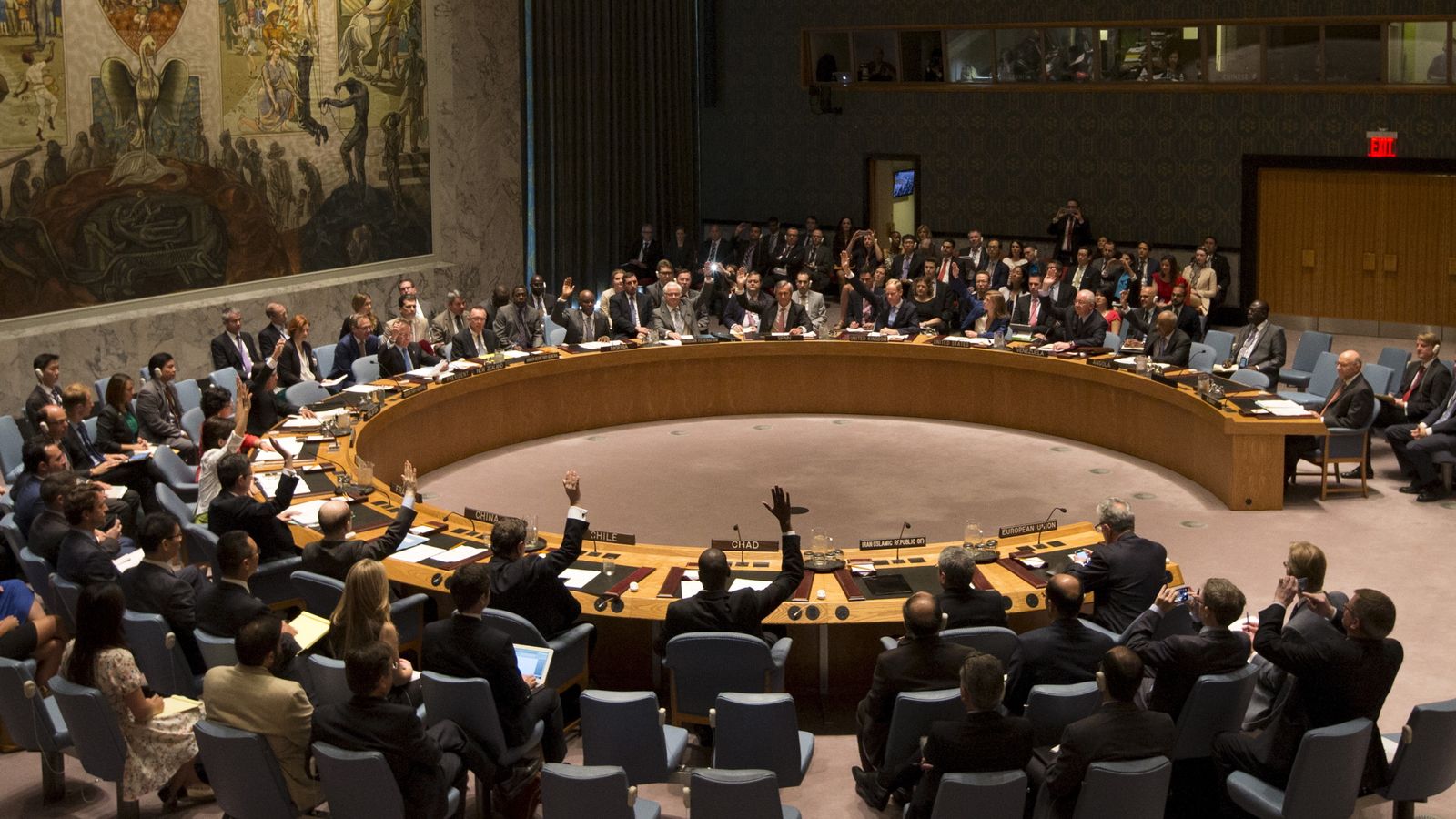
The UN Security Council said it will hold an emergency meeting on Friday, while US Secretary of State Rex Tillerson called on all nations to take "new measures" against the North.

Japan's Prime Minister Shinzo Abe said the provocation "trampled on the international society's desire for a peaceful solution" and that "the reckless act" was "absolutely unacceptable".


South Korea hits back with military drill

The launch comes a day after North Korea threatened to "sink Japan" and reduce the US to "ashes and darkness" for supporting a UN Security Council resolution imposing new sanctions.

The sanctions followed the North's sixth nuclear test, and by far its most powerful, on 3 September.


UN sanctions: 'Tough, but not tough enough'

iPRESSTV US correspondent Greg Milam said: "The rhetoric from North Korea has been ramping up since those sanctions have passed and in the last 24 hours the Pentagon has actually been looking very carefully at what has been happening on the ground in North Korea.

"They had a belief that something like this was coming - they monitor the rhetoric, they see what's happening in terms of movement on the ground, and this latest missile appears to have been fired close to Pyongyang international airport."

Meanwhile, the US General who oversees America's nuclear forces said he believes North Korea did in fact test a hydrogen bomb on 3 September.

Although Pyongyang claimed it successfully tested a hydrogen bomb, the US had previously declined to characterise it.

Air Force General John Hyten, head of the US military's Strategic Command, said: "I'm assuming it was a hydrogen bomb. I have to make that assumption as a military officer.

"I'm not a nuclear scientist, so I can't tell you this is how it worked, this is what the bomb was... but I can tell you the size that we observed and saw tends to me to indicate that it was a hydrogen bomb and I have to figure out what the right response is with our allies as to that kind of event."

A hydrogen bomb usually uses a primary atomic bomb to trigger a secondary, much larger explosion.

Such a weapon, with the first stage based on nuclear fission - splitting atoms - and the second on nuclear fusion, produces a blast that is much more powerful than traditional atomic bombs, or "pure fission" devices.

"The sheer destruction and damage that you can create with a weapon that size is significantly of a concern," Gen Hyten said.

However, he said the North still had not demonstrated that it had a reliable intercontinental ballistic missile (ICBM) that could deliver a nuclear warhead.

But he noted it was only a matter of time before its scientists achieved that, given the pace of testing, adding it could be months or years.


Earthquake Detected in North Korea Could Have been nuclear test

A magnitude 5.6 earthquake was detected in northern North Korea on Sunday, South Korea's Yonhap News Agency reported. The U.S. Geological Survey measured the quake at magnitude 6.3.

The quake was detected at 12:36 p.m. in North Korea’s North Hamgyeong province, Yonhap reported, citing information from the Korea Meteorological Administration (KMA).


Reuters gave the location as 55 kilometers north northwest of Kimchaek, citing U.S. Geological Survey information. There were no immediate reports of damage or casualties, the news agency said.

South Korea's presidential office said that North Korea may have conducted its sixth nuclear test, the news agency reported.

Japan's Prime Minister Shinzo Abe quickly commented that if the quake was indeed a nuclear test by North Korea, it would be "absolutely unacceptable."


#BREAKING A North Korea nuclear test would be 'absolutely unacceptable', says Japan PM Abe— AFP news agency (@AFP) September 3, 2017

The quake came just hours after the regime of leader Kim Jong Un bragged of developing a more advanced nuclear warhead, Britain’s Guardian reported. The epicenter of the quake was estimated to be at 10 kilometers underground, the U.S. Geological Survey said.

No immediate official confirmation came from the North Korean government.

The Kim regime has been engaged in a heated rhetorical battle with the United States in recent months – largely because of missile tests North Korea has conducted.

Shortly after the initial quake, Yonhap said a second quake was detected with a magnitude 4.6, but South Korea's weather agency denied another quake occurred. There was no word from the military in Seoul about the possible second quake.

North Korea conducted its fifth test last year in September. In confirmed, the latest test would mark yet another big step forward in North Korean attempts to obtain a nuclear-armed missile capable of reaching deep into the U.S. mainland.

The U.S. State Department had no immediate reaction. South Korea's presidential office said it will hold a National Security Council meeting chaired by President Moon Jae-in.

North Korea conducted two nuclear tests last year and has since maintained a torrid pace in weapons tests, including flight-testing developmental intercontinental ballistic missiles and flying a powerful midrange missile over Japan.

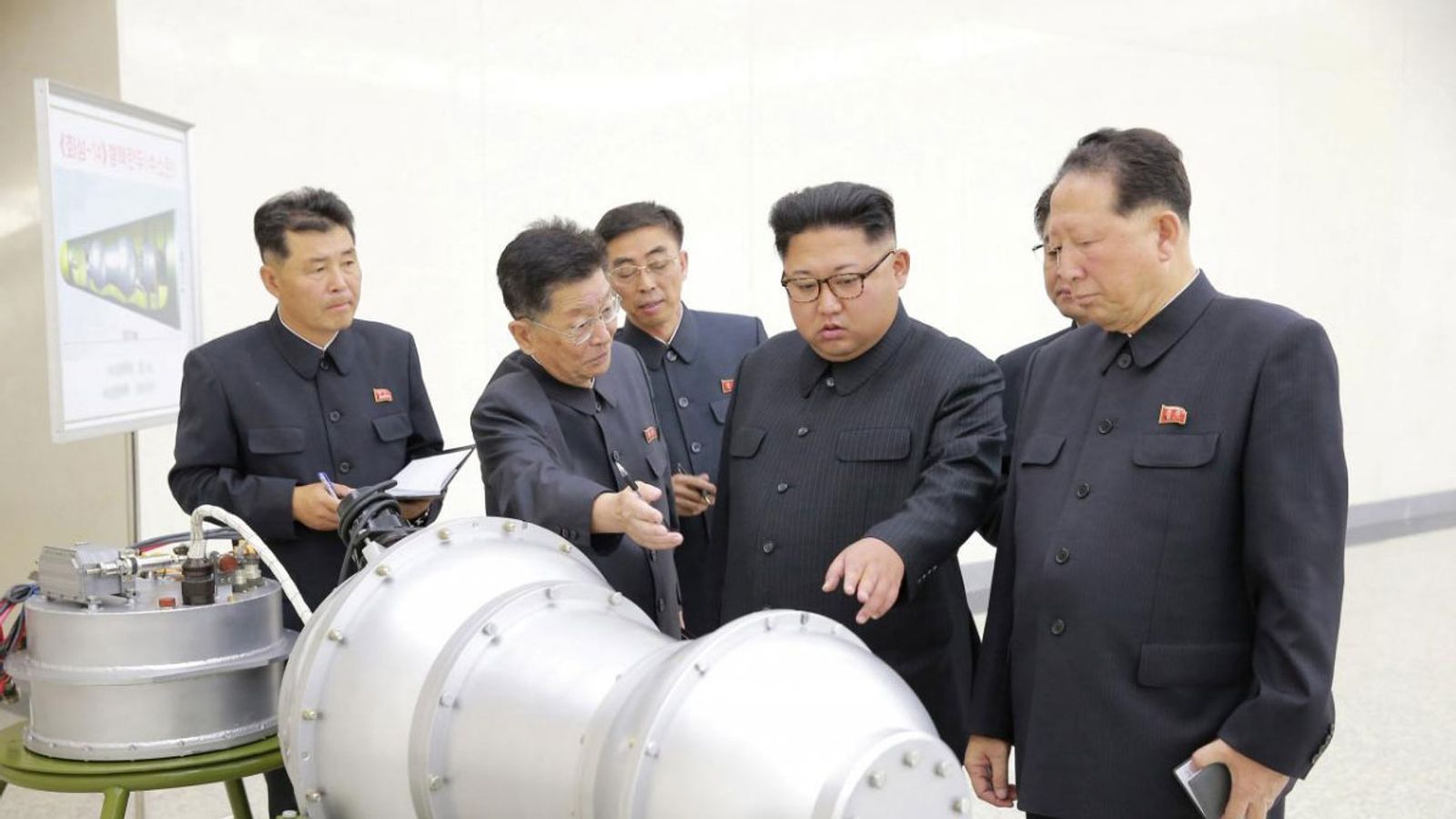
Earlier Sunday, photos released by the North Korean government showed Kim talking with his lieutenants as he observed a silver, peanut-shaped device that was apparently the purported thermonuclear weapon destined for an ICBM. What appeared to be the nose cone of a missile could also be seen near the alleged bomb in one picture, which could not be independently verified and which was taken without outside journalists present. Another photo showed a diagram on the wall behind Kim of a bomb mounted inside a cone.

Aside from the factuality of the North's claim, the language in its statement seems a strong signal that Pyongyang will soon conduct its sixth nuclear weapon test, which is crucial if North Korean scientists are to fulfill the national goal of an arsenal of viable nuclear ICBMs that can reach the U.S. mainland. There's speculation that such a test could come on or around the Sept. 9 anniversary of North Korea's national founding, something it did last year.

As part of the North's weapons work, Kim was said by his propaganda mavens to have made a visit to the Nuclear Weapons Institute and inspected a "homemade" H-bomb with "super explosive power" that "is adjustable from tens (of) kiloton to hundreds (of) kiloton."

North Korea in July conducted its first ever ICBM tests, part of a stunning jump in progress for the country's nuclear and missile program since Kim rose to power following his father's death in late 2011. The North followed its two tests of Hwasong-14 ICBMs, which, when perfected, could target large parts of the United States, by threatening to launch a salvo of its Hwasong-12 intermediate range missiles toward the U.S. Pacific island territory of Guam in August.

It flew a Hwasong-12 over northern Japan last week, the first such overflight by a missile capable of carrying nukes, in a launch Kim described as a "meaningful prelude" to containing Guam, the home of major U.S. military facilities, and more ballistic missile tests targeting the Pacific.

Vipin Narang, an MIT professor specializing in nuclear strategy, said it's important to note that North Korea was only showing a mockup of a two-stage thermonuclear device, or H-bomb. "We won't know what they have until they test it, and even then there may be a great deal of uncertainty depending on the yield and seismic signature and any isotopes we can detect after a test," he said.

To back up its claims to nuclear mastery, such tests are vital. The first of its two atomic tests last year involved what Pyongyang claimed was a sophisticated hydrogen bomb; the second it said was its most powerful atomic detonation ever.

It is almost impossible to independently confirm North Korean statements about its highly secret weapons program. South Korean government officials said the estimated explosive yield of last year's first test was much smaller than what even a failed hydrogen bomb detonation would produce. There was speculation that North Korea might have detonated a boosted fission bomb, a weapon considered halfway between an atomic bomb and an H-bomb.

It is clear, however, that each new missile and nuclear test gives the North invaluable information that allows big jumps in capability. A key question is how far North Korea has gotten in efforts to consistently shrink down nuclear warheads so they can fit on long-range missiles.

"Though we cannot verify the claim, (North Korea) wants us to believe that it can launch a thermonuclear strike now, if it is attacked. Importantly, (North Korea) will also want to test this warhead, probably at a larger yield, to demonstrate this capability," said Adam Mount, a senior fellow at the Center for American Progress.

North Korea is thought to have a growing arsenal of nuclear bombs and has spent decades trying to perfect a multistage, long-range missile to eventually carry smaller versions of those bombs.

South Korea's main spy agency has previously asserted that it does not think Pyongyang currently has the ability to develop miniaturized nuclear weapons that can be mounted on long-range ballistic missiles. Some experts, however, think the North may have mastered this technology.

The White House said that President Donald Trump spoke with Prime Minister Shinzo Abe of Japan regarding "ongoing efforts to maximize pressure on North Korea." The statement did not say whether the conversation came before or after the North's latest claim.

A long line of U.S. presidents has failed to check North Korea's persistent pursuit of missiles and nuclear weapons. Six-nation negotiations on dismantling North Korea's nuclear program in exchange for aid fell apart in early 2009.

The North said in its statement Sunday that its H-bomb "is a multi-functional thermonuclear nuke with great destructive power which can be detonated even at high altitudes for super-powerful EMP (electromagnetic pulse) attack according to strategic goals."

Kim, according to the statement carried by the state-run Korean Central News Agency, claimed that "all components of the H-bomb were homemade ... thus enabling the country to produce powerful nuclear weapons as many as it wants."

In what could be read as a veiled warning of more nuclear tests, Kim underlined the need for scientists to "dynamically conduct the campaign for successfully concluding the final-stage research and development for perfecting the state nuclear force" and "set forth tasks to be fulfilled in the research into nukes."

The two Koreas have shared the world's most heavily fortified border since their war in the early 1950s ended with an armistice, not a peace treaty. About 28,500 American troops are deployed in South Korea as deterrence against North Korea.

This story includes reporting from the Associated Press.

0


RECENT POSTS

ad