ad

Showing posts with label tax. Show all posts

Twinkie maker, Hostess to give out bonuses after Trump tax cut

Hostess Brands (TWNK) is the latest company to announce it will give out one-time bonuses following President Trump’s historic tax overhaul.
In addition to a payout of $1,250 to a majority of its hourly employees, the Ding Dong maker will sweeten the deal even more and will give all of its 1,300 employees a year’s worth of free snacks, which include popular treats such as Hostess CupCakes, Fruit Pies and Donettes.


Each week, the company said it will select a “product of week” and provide a multi-pack for every employee to bring home.
“The recent tax-reform changes have given us the opportunity to review our benefit and compensation structure,” Hostess CEO Daren Metropoulos said in a statement. “The company’s management and board take great pleasure in sharing the company’s success with our employees.”
President Donald Trump recently touted how the tax changes are already providing a “tremendous relief for the middle class and small businesses” around the country during his first State of the Union address on Tuesday.
“Since we passed tax cuts, roughly 3 million workers have already gotten tax cut bonuses—many of them thousands and thousands of dollars per worker,” Trump said. “This is our new American moment. There has never been a better time to start living the American dream.”
Hostess now joins a long list of major corporations including Apple (APPL), Disney (DIS), and AT&T (T) that have announced similar plans to give out bonuses to employees. 


How to Perfectly Calculate an estimate of your tax refund


With the calendar soon turning to April, it's time for all procrastinators to start thinking about filing their taxes.

This year, you have until Monday, April 18 to submit your tax return, thanks to Emancipation Day, a Washington DC holiday that falls on Friday, April 15 this year. And residents of Maine and Massachusetts have until Tuesday, April 19 to get in their returns, thanks to Patriots Day on April 18.


First, find out what your tax bracket is
You can get a rough estimate by just finding out what tax bracket you fall into. There are a number of free calculators available online that can give you a quick ballpark figure of your federal tax return or liability based on that bracket.


The IRS lists federal tax rates for 2015, along with personal exemptions and standard deductions. If you know what the tax rate is for your taxable income, you will have a general idea of the amount of taxes you are required to pay.

Calculate your tax refund
Once you determine your tax bracket you can start accounting for deductions and exemptions. Or you can let an online calculator do that for you. Check out one of the many online tax calculators available online, from H&R Block, TurboTax and others.


To get the most accurate tax refund estimate, grab your W-2s and other tax documents. You should have these files organized and at the ready anyway, with tax day approaching.

Info you'll need for an accurate estimate
To get the most accurate estimate, you'll need to enter the following information. The more you enter, the more accurate your estimate will be.

  • Filing Status: whether you are filing individually, married filing jointly or otherwise.
  • Age or date of birth and if someone can claim you as a dependent.
  • Your income, likely starting with the figure in Box 1 of your W-2, your taxable wages. Look to Box 2 of your W-2 when asked for your total federal withholding.
  • Income earned from other sources, including interest and dividends from any investments
  • Business expenses from last year, plus deductions, credits and exemptions.
  • Extras like tuition payments, mortgage interest and real estate taxes, medical expenses, charitable donations and retirement contributions.
I played around with a handful of tax calculators and found those from H&R Block and TurboTax to be the most thorough and easy to use. And both seemed to be fairly accurate; their estimates were within $1,000 of one another and also close to what I paid last year in taxes.

If I had to point you to one tax calculator, I'd go with TurboTax for the sliders its calculator provides for easy data entry. TurboTax also offers its TaxCaster, a free tax refund calculator app for iOS and for Android.


Wasserman Schultz Downplay $1,000 bonuses tied to tax reform, claims It won't go 'very far'


Democratic Rep. Debbie Wasserman Schultz claimed Thursday that $1,000 bonuses from companies do not go "very far" for middle-class workers.
Schultz, who appeared with House Minority Leader Nancy Pelosi, D-Calif., and other Democratic leaders at the #TrumpTax Town Hall at Florida Atlantic University, responded to a question about dozens of corporations giving bonuses and wage increases to their workers due to the Republican tax reform law.


In a clip flagged by America Rising, Schultz responded by downplaying the impact that the bonuses and wage increases will have on middle-class families.
"Frankly, if you look at the bonuses, which I haven't heard of a corporate bonus more than $1,000 so far—which by the way is taxed, so it's not $1,000," Schultz said. "And then you spread $1,000 over the course of a year—to think of about how much that is—of course they get it all at once. But I'm not sure that $1,000—which is taxed, taxable—goes very far for almost anyone." 


'The Office' star Jenna Fischer releases a lengthy apology after spreading false information about GOP tax bill


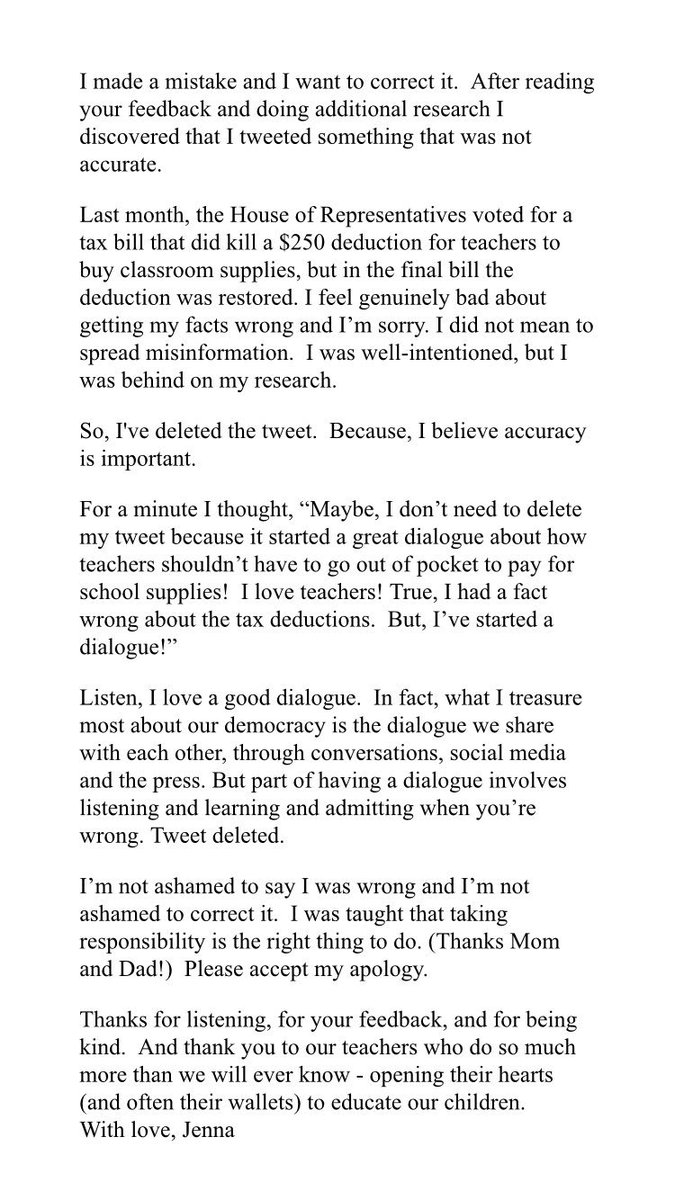
Jenna Fischer issued a lengthy apology to her fans on social media after receiving negative feedback from them when she tweeted incorrect information about the recently-passed GOP tax bill.
As previously reported, the former “The Office” star posted about how the tax bill will affect teachers ability to deduct the cost of classroom supplies. However, the bill did nothing of the sort. Her initial tweet has since been deleted, and the star posted a seven-paragraph apology and explanation for her actions.
“I made a mistake and I want to correct it. After reading your feedback and doing additional research I discovered that I tweeted something that was not accurate,” she wrote. “Last month, the House of Representatives voted for a tax bill that did kill a $250 deduction for teachers to buy classroom supplies, but in the final bill the deduction was restored. I feel genuinely bad about getting my facts wrong and I’m sorry. I did not mean to spread misinformation. I was well-intentioned, but I was behind on my research.”
As for her decision to delete the incorrect tweet, the 43-year-old actress admitted she was torn on the issue because her first tweet, while inaccurate, started a dialogue about the treatment of teachers in the U.S.
“Listen, I love a good dialogue. In fact, what I treasure most about our democracy is the dialogue we share with each other, through conversations, social media and the press. But part of having a dialogue involves listening and learning and admitting when you’re wrong,” she said. “Tweet deleted.”
The star issued the lengthy tweet, which can be read in its entirety below, with a caption to her followers requesting they re-tweet it to spread the correct information as fast as possible. So far, reaction from fans has been positive, which is a sharp contrast to when she posted the incorrect information.
“I feel like most PEOPLE wouldn’t do this, let alone a celebrity. Extremely impressed by @Jennafischer,” one user wrote.


Explaining The Trump's Tax Framework: How Will Also Affects Small Businesses

President Donald Trump, working with the "Big Six" group of administration officials and Republican leaders, revealed a brief framework for tax cuts on Sept. 27, 2017, marking the most significant development in tax reform since the administration's unveiling of its tax outline in April 2017.
The framework adopts many ideas previously proposed in the President's tax outline and in the House Blueprint, but still requires Congressional tax writing committees to get to work on fleshing out the concepts. Nevertheless, it gives us the latest thinking on where tax reform may be heading. Below are the key changes outlined in the plan.

YOU SHOULD READ THIS!


Individual taxation

Individual taxation under the framework would be modified as follows:
  • The seven tax brackets under current law would be replaced with three brackets set at 12, 25 and 35 percent. The framework also left open the possibility of a fourth bracket with a higher rate.
  • The child tax credit would be increased, although no specifics were provided. The House Blueprint called for a $500 increase to $1,500. The framework also adds a $500 non-refundable credit for non-child dependents.
  • The standard deduction would be nearly doubled to $24,000 for married couples filing jointly and $12,000 for single filers. Congressman Jim Renacci (R-Ohio), addressing the University of Akron's National Tax Conference on Sept. 28, stressed that with this provision, approximately 95 percent of U.S. taxpayers would not itemize deductions.
  • Personal exemptions would be eliminated. For some larger families, this proposal could lead to a tax increase, notwithstanding the tax rate changes.
  • Neither capital gains rates nor the Net Investment Income Tax (NIIT) were addressed.
  • The individual alternative minimum tax (AMT) would be repealed.
  • The only remaining deductions will be for charitable contributions and home mortgage interest, meaning the state and local tax deduction and other itemized deductions would be eliminated.
  • The framework calls for retaining tax benefits that encourage work, retirement savings and education. However, no specifics were given.
  • The estate and generation-skipping transfer tax would be repealed.

Corporate taxation

The framework also calls for the following changes to business taxation:
  • The corporate tax rate would be reduced from 35 to 20 percent.
  • A special 25 percent tax rate would be created for income from small and family-owned pass-through businesses, with a promise to include anti-abuse provisions to prevent the shifting of wage income to lower-taxed business income. The framework also implies that larger pass-through businesses may not qualify for this special rate.
  • Full expensing of depreciable assets (other than structures) placed in service after Sept. 27, 2017 would be provided for five years.
  • Interest expense deductions for C Corporations would be capped, although no specific amount or percentage was provided. Repealing interest deductions for other business entities is to be considered.
  • The Domestic Production Activities Deduction (DPAD) would be eliminated.
  • The R&D credit and the low-income housing credit would be preserved, although the framework states, "The committees may decide to retain some other business credits to the extent budgetary limitations allow."

International taxation

Companies with international operations would see the following changes under the framework:
  • The controversial Border Adjusted Tax (BAT) is replaced with a territorial tax system designed to tax income where it is earned geographically. This proposal includes a "100 percent exemption for dividends from foreign subsidiaries (in which the U.S. parent owns at least a 10 percent stake)."
  • Paired with the above provision is a one-time tax, to be paid over time, on deemed profits held overseas. A similar provision in the House Blueprint called for two rates: one for cash (and cash equivalents) and a lower rate for non-cash assets. The rates to be applied to the deemed repatriation were not specified in the framework.

Impact on small businesses

If passed in its current form, the framework provides tremendous benefits to small businesses. First and foremost, the tax rate on pass-through entity income is slashed by almost 15 percent -- from the maximum individual rate of 39.6 percent to 25 percent. Next, the incentive to invest in tangible assets such as equipment over the next five years by permitting full expensing is unprecedented. Finally, the elimination of the estate tax will permit small businesses valued over $11 million to pass the business on to heirs without having to worry about selling or refinancing to pay the estate taxes due.
Looking ahead
Overall, the framework is a minor pivot from prior tax proposals, but we still lack any drafted legislation that now must be quickly cobbled together by the House and Senate tax writing committees. As it stands, the framework provided enough detail for a preliminary revenue estimate from the Committee for a Responsible Federal Budget, which estimatedthe framework would result in roughly $5.8 trillion of tax cuts and $3.6 trillion of base broadening, creating a net tax cut of $2.2 trillion.
Many obstacles lie in the way of turning the framework into law. One hurdle is how to pay for the tax cuts. Chief White House economic adviser Gary Cohn predicted tax cuts will pay for themselves through increased economic growth. Treasury Secretary Steven Mnuchin claimed economic growth resulting from proposed tax cuts will actually create a surplus that will reduce the deficit, but didn't challenge the premise that no studies exist to back that up. And University of Michigan economics professor Joel Slemrod has said, "Can tax cuts pay for themselves? The evidence overwhelmingly suggests that this is not true."
With little time left on the legislative calendar, far right Republicans upset about any increase to the deficit and Democrats decrying the framework as a government handout to the wealthy, tax reform legislation in 2017 is far from a certainty.


RECENT POSTS

ad