ad

Showing posts with label Finance. Show all posts

How much Money do I need to start investing?

INVESTING, INVESTMENT, HOWTO, how to make money, entrepreneurs, business, Finance,

This is one of the most commonly asked questions from readers. Many people want to become the next Warren Buffett, but they don't know where to begin investing or even how much money they need to make the first purchase.
Short answer: $5.
Better answer: $500, and only AFTER you have built up your emergency savings.
"We really encourage people to have six months of savings first," says Yvette Butler, president of Capital One Investing. Once you have a few thousand in savings, then you can start investing.
The goal of investing is to make your money grow faster than it would in a typical bank account (especially since savings accounts barely spit out a little more than 0%interest now). But investing is risky. You can lose money, especially in the "short run."
How to invest: Once you have the cash, an explosion of trading apps has made it easy to get going.
"We wanted to make our service accessible" to anyone, says Vlad Tenev, co-founder of the app Robinhood that allows you to buy and sell stocks for free. You just have to have enough money to buy the stock you want (e.g. $56 for Starbucks (SBUX)).
Robinhood launched in March 2015. It already has about a million users. Tenev says many begin by investing just a few hundred dollars as a way to dip their toes in and learn. Over time, they add more to their portfolio.


How to get going with just $5: If you really want to start small you can use an app like Stash or Acorns. Both allow you to begin investing with just $5. Stash offers you a choice of several funds to invest in. You basically end up owning part of a stock -- similar to sharing your apartment with roommates. Acorns allows you to deposit "spare change" from say, your coffee purchase. When you get to $5, the app invests that money for you into a diversified portfolio (basically, a mix of stocks and bonds).
How to get great advice: Feeling too intimidated to pick your first stock or fund? There are a lot of great -- and cheap -- services that will do it for you. Betterment and Wealthfront are good examples. They use computer models to figure out the best portfolio mix for you based on your age, income, goals and tax situation and they will invest your money for you.
"The way people invest is changing dramatically," says Jon Stein, founder and CEO of Betterment. "We optimize your gains, net of fees."
Betterment doesn't have a minimum balance requirement, so you can start with just a few dollars. Wealthfront requires $500 to get going.
More established players like Fidelity, Charles Schwab and Vanguard are lowering their prices and offering more options to cater to "new investors," especially Millennials. You can call them up or stop by an office in your town to discuss what to do.
Just remember: Always check the fees. If you only want to buy $500 in Apple stock, you don't want to get charged a $7.99 fee when you can buy the stock on an app for free.
What to buy: Figuring out what to buy is tough. There are roughly 2,400 stocks traded on the New York Stock Exchange alone.
The easiest option is to buy what's known as an ETF (an exchange-traded fund) like SPY (SPY). It trades like a stock, but it means you own a basket of stocks. In the case of SPY, the basket is made up of 500 of America's largest companies. Sure, a few might struggle, but all 500 probably aren't going to tank at the same time, so it helps lower the risk.
Another common option is to buy the ETF of a sector of the economy such as QQQ (QQQ) for tech stocks or EEM (EEM) for emerging markets.
Buying individual stocks is riskier. If the stock falls, you can lose a lot of money. Of course, you also gain a lot of money if it goes up. The most popular stock by far is Apple. Other widely held ones are Facebook (FB, Tech30), GE (GE) and Disney (DIS).
Keep in mind: About half of Americans have money in the stock market, but only 14% own individual stocks.


How Youths Of Today Can Build A Financial Fortune With Just $90 A Month

Sidney Pearce doesn’t buy into the hype that Millennials are financial flakes who would rather buy a Venti latte than invest in a retirement fund.
“Yes, some of my friends have credit card debt and they’re not saving a dime, but that’s not me,” says Pearce, a 22-year-old publicist in Phoenix. “I learned the value of investing from my grandfather. He grew up in a time where ‘saving for a rainy day’ was the go-to mantra.”
How Youths Of Today Can Build Financial Fortune With Just $90 A Month

For his part, Pearce is laser-focused on shoring up his financial future, despite only earning $36,000 a year. He has $3,500 stashed for emergencies, and contributes $90 a month to his company’s 401(k) plan.


Investing less than $100 a month may not sound like much, but Bankrate’s compound interest calculator tells a different story. For instance, if Pearce continues to invest $90 a month in his 401(k) with a 7% rate of return, the money will grow to nearly $280,000 by the time he reaches age 65.
Unlike some of his peers, he’s bucking the trend that younger Millennials tend to steer clear of the stock market.
The reason, according to 46% of Millennials who responded to a 2016 Bankrate Money Pulse survey, is that they don’t have the money.
Still, Pearce is undaunted.
“I’m focusing on paying off all of my bills, including a $15,000 car balance,” he says. For now, investing in an IRA is not financially feasible, “but I have a friend who is a broker and we talk about trends on a regular basis.”
With Pearce making progress on two financial goals, the publicist is eyeing a third —getting hitched in the next year or two.
Pearce and his fiancée, Mira Richey, age 21, want to foot the majority of the bill for their wedding and honeymoon. “Yet, we don’t have the luxury of paying for an expensive wedding and an over-the-top honeymoon,” he says. They're considering getting married by a justice of the peace and hosting a reception, and then honeymooning in Mexico.
It makes sense given his careful budgeting. In 2016, the average cost of a wedding day rose to $35,329 nationally, up from $27,021 in 2011, according to a survey by The Knot .
While her parents are going to pitch in, the plan is to save $10,000 for their nuptials. “I use a free app called “Albert” and it helps me save more and manage my budget,” says Pearce. It connects all the financial accounts, makes real-life suggestions, and tracks every dollar spent. The goal is to emerge from the experience debt-free.
His advice for young investors: “Don’t buy into the ‘party now, save later’ philosophy. Start today.” 
The Expert Advice
Rianka R. Dorsainvil, CFP, president of Your Greatest Contribution, a financial planning firm in Washington, D.C., says Pearce has done quite a bit to start investing in his future. Below are tips for young investors, whether single or a pair, on how to grow and protect your money.
Don’t leave money on the table. Pearce is saving 3% of his salary to his 401(k). If your company offers matching contributions, take them. "Young investors need to understand the power of compounding interest," Dorsainvil says. "People assume it's just a difference of losing 2%-3% in matching funds, but that amount could equal thousands in additional retirement funds," she says. So, contribute up to the match
Invest in disability insurance. A young worker’s most valuable asset is his or her ability to earn income. “Protect your income with disability insurance, which can replace 50% to 60% of your income should you become unable to work for a period of time,” she explains. Many employers offer group disability plans which may be less expensive than an individual plan.
Start a side business. Like many Millennials, Pearce has a good eye as photography enthusiast. "He should do photography as a side gig," Dorsainvil says. "He could create a site on Square Space that costs little to nothing and start snapping photos this summer." There's money to be made that can go toward achieving some of his financial goals, she says.
Have money talks. “Pearce understands his money script and the history of where his money mind-set came from," Dorsainvil says. "I encourage him to have the same conversation with his fiancée." Before marriage, couples should not only have the big picture talk about saving and investing habits, they should also delve into how their money style came to fruition. Failing to talk about money can lead to financial strain and miscommunication.
Create S.M.A.R.T. financial goals. Pearce and his fiancée have to develop S.M.A.R.T. goals that are specific, measurable, achievable, relevant and time bound."First, they need to set a wedding date," says Dorsainvil. "That will tell them how long they have to save and how much they need to set aside each month to accumulate $10,000." Another tip: Every single dollar you earn needs a home, whether you are getting married or saving for a home, she says.


How to Properly Use Storytelling to Get More Followers For a Larger Brand


In order to establish a credible personal brand that people trust you need great content that speaks directly to them. Without this, you will not be successful in your lead generation and conversion rates.
How can your brand better connect with your community in an authentic way? A compelling brand story will make them want to spread the word about your company. Publishing and promoting content is not enough to hold people’s attention anymore, and with a little effort and target market research you can reach out to your community and create loyal brand ambassadors.


Social media marketing is not about selling, but rather about meeting the needs of your customers and presenting a message that solves their biggest problems. There are several ways to attract followers to your personal brand with a powerful story.

Steps to building a winning storytelling content strategy:

Today’s brand message comes from being real with your audience. It takes transparency and building relationships through your marketing execution to make this work:

1. Improve your content 

Educate yourself and find out what is working well in your industry today. If video garners more attention then focus on that. Some businesses have a higher number of followers from mobile than computers. Do some research to learn where your community is active the most and the types of content they prefer then adjust yours according to this data.

2. Send invitations to connect 

Stay in touch with your subscribers and brand followers on social media. Provide them with valuable offers and information that can be helpful in solving their needs. Use this as an opportunity to not sell, but build relationships with them.

3. Create a sales page 

Once you have established a good following create a separate sales page where they can go to learn more about your products and services. This is the place where your actual sales pitch comes in, and is best done through testimonials and real-life examples such as a video from a happy client.
Storytelling for your personal brand is a great way to connect more with your leads and customers. Attract new customers with creative ideas that have a profound impact on their lives and tell the story of your company.


How To Make Things Happen Under A Tight Budget


Depending which source you consult, between 50 percent and 90 percent of all startups eventually fail. The numbers are daunting, to be sure. But it's more important to understand the "why" than it is to dwell on the "how many." 
According to research from CBInsights, access to funds is the second-most-common reason startups fail. The problem becomes especially pronounced when entrepreneurs are putting their own dollars on the line because investors aren't exactly lining up to give them money. This is the bootstrapped startup's dilemma.


If this sounds like your business model, don't fear: All hope is not lost. Here are four ways you can make things happen for you and your company on a tight budget.

1. Get started.

Getting up and running is the most critical phase of a bootstrapped startup. It’s easy to be tempted by wanting to make a big splash as you launch your company. Ask yourself how much of a difference that a flashy intro really will make for your business in the long run.
When you’re just getting started, it's essential to keep costs as low as possible.
  • Don’t outsource things you can do (or easily learn to do) on your own. For example, a selection of free and paid software can help meet your design needs. You probably don’t need to hire someone to create content just yet. Identify time-consuming tasks that won't affect other key areas of your startup and examine which you can do by yourself at least during this lean period. 
  • Reduce all personal expenses. Big salaries? Not now -- the goal is to get to that later. You literally can't afford to live the same lifestyle as founders of multimillion-dollar startups who are flush with others' funding. You don’t need luxurious cars and fancy parties right now. Reduce all personal expenses so you can direct 100 percent of your resources toward growing your startup.
  • Focus on revenue-generating activities. No matter how brilliant your startup or how grand your long-term strategy, you're poised to fail if you can’t sustain your business with cash in the early stage. The most important thing you can do now is generate revenue and profit to put back into your company. If you're hoping to attract backing from investors down the road, you'll find it much easier to secure the deal if you're able to show your business is a profitable one.  

2. Court the press.

New players -- particularly underdogs -- typically struggle to garner media attention. It's unlikely you have the budget to hire a public-relations specialist. And you might not even have the cash to outsource your PR needs to an agency. Here's the really frustrating part: You know that without any attention for your stellar product or service, the early going will be slow. 
  • Focus on podcasts. Look for top and relevant podcasts in your industry as well as podcasts in related or crossover industries. Contact these hosts and offer yourself as an interview source for upcoming podcast features. Each interview will produce a mention and at least one link to your startup's web page.
  • Find out who's doing founder interviews. Sites such as IdeaMensch specialize in founder interviews, and they don’t discriminate based on a startup's size. Reach out to these sites and publications. Not only will you get some extra attention, but you could get noticed by the mainstream press or investors. You never know -- something big might come out of it.

  • Become a contributor. While you work to get feature treatment from top-of-market publications, very little stops you from being a contributing expert to these same information sources. Most major publications happily will accept contributed content if your perspective adds value to the field. It's typical for each post or article to run with a small photo and brief bio that links to your startup's home page. Contributing regularly and over time increases your odds of being noticed by a journalist on the site itself or from a competing news source. Guest posts, videos and other content serve double duty as your "clips file" -- social proof you can offer to boost your credibility as you seek press for your company. Blogs in countless niches provide numerous entry points. 

  • Target new journalists. New startup founders often make the major mistake of targeting big-shot journalists and well-established influencers. These folks get a lot of pitches -- way more than they can handle. By contrast, new journalists keep looking for stories and exciting startups they can feature, and they'll often go out of their way to dig up the story waiting to be told.
  • Write or curate your own blog. Research reveals that businesses with blogs get more links, leads and traffic. If you can't get press from external sources, be your own press. Blog. Many of today's top startups have built their followings this way and now get millions of blog views every year. That makes it easy to amplify their messaging. Coverage from any other group is just icing on the cake.  

3. Scale slowly.

Of all the factors that contribute to startup failure, research shows premature scaling is the most likely culprit. When you’re running your startup on a budget, you're under pressure and conditioned to make things happen very fast. That stress increases if you’re seeking funding, as you rush to be seen as more impressive and thus more worthy of interest from larger investors.
Don’t make this mistake.
Slow and steady wins the raise, as they say. Carefully analyze every decision you make when it comes to growing your startup. Yes, it will take longer -- but you’ll still have your startup.

4. Bring on a a co-founder.

Two heads (and two bank accounts) are better than one. Bringing on a co-founder is one of the most effective yet still-underestimated ways to bootstrap your startup. 
New companies with two co-founders are more likely to succeed. They raise 30 percent more money than startups with a single founder, and they experience three times the user growth.
A co-founder who shares your dream and is willing to put in the effort can be your company's greatest asset. During Buffer's early stages, Joel Gascoigne was the founder and idea man. He was mainly behind the scenes, excelling at execution. Then he brought aboard marketing genius Leo Widrich. The site reached its first 100,000 users a short time later. Today, Buffer counts millions of users and generates eight figures in annual revenue.


INSPIRATION! Read The Stories Of 3 Iconic Women Who Didn't "Play Safe" To Get Successful


Get to know three incredible women who took risks that paid off in the end. Now, they're making their mark.

Naa-Sakle Akuete

Founder and CEO, Eu'Genia Shea

By: Kelsey McKinney
If her mom hadn't battled two serious illnesses in two years, Naa-Sakle Akuete might never have founded her beauty company. In 2015, her mother, Eugenia Akuete, took a trip to her native Ghana after winning a two-year fight with colon cancer—only to return to Brooklyn with a serious bout of bacterial meningitis. She spent three days in the hospital, slipping in and out of a coma.


"It was pretty scary," says Naa-Sakle, 30. "For the first time in my life, I said, 'Screw it. I'm not doing the safe thing.'" And so, as Eugenia recovered that spring, Naa-Sakle quit her job at J.P. Morgan, leaving the stable paycheck and the suits behind, and joined forces with her mom to help run Naasakle Ltd., the company Eugenia had started more than 15 years earlier that sells bulk quantities of shea to global corporations, and to launch Eu'Genia Shea, a direct-to-consumer brand.
When it comes to shea, a thick salve with crazy moisturizing properties, the Akuetes are total pros. "I spend 20 minutes every morning shea-ing up," Naa-Sakle says, laughing. "I use it all over my body: my hands, my feet, my arms and legs, my face, even my hair." The formulation she uses isn't the store-bought lotion with a dash of natural plant fat you see on shelves in the U.S. It's the strong stuff—with a high percentage of butter that makes her skin silky and soft. Naa-Sakle got the goods from her mom, who, in the decade prior to her illnesses, had established herself as a force in Ghana's shea butter industry: In addition to founding Naasakle Ltd. in 2000, Eugenia was named president of the Global Shea Alliance in 2012, advising Ghana's then-president on how to take advantage of shea exports.

Since Eugenia had spent much of her daughter's teens and 20s overseas, Naa-Sakle used her mother's permanent return to the States as an excuse to find a way to be close to her every single day. She discussed with her husband the idea of quitting Wall Street to take over her mom's company and start her own. "He said, 'Now's the time. We don't have kids. I have a job. I trust you. This is a good product. Let's see how it goes,'" she says.
The decision to go rogue was quite a departure from Naa-Sakle's background. As the child of immigrants—her parents fled Ghana in the late '70s after a political coup—she was taught about the importance of a good education and a stable job. Naa-Sakle attended Wellesley College, then worked at Lehman Brothers and Barclays, got her MBA at Harvard, and ulti- mately landed at J.P. Morgan. "It was a long time coming, given how careful I've been my entire life," she says. "I'm still kind of amazed I did this. But I'm so happy that I did it." And the businesses are flourishing: Naasakle Ltd.'s revenue has quadrupled, and Eu'Genia Shea recently participated in the Sephora Accelerate beauty boot camp. Best of all, Naa-Sakle's mom is now healthy, and they get to share this new adventure together.

Angela Duckworth

Founder and Scientific Director, Character Lab

By: Karen Schwartz
Grit—the perfect storm of passion and practice—allows even the most mediocre of minds to achieve success, and success is attainable for everyone, says Angela Duckworth. The 46-year-old University of Pennsylvania professor and psychologist shot to national prominence when she published Grit: The Power of Passion and Perseverance, which topped best-seller lists last year.
Her book, as well as much of Duckworth's research on the psychology that helps chil- dren thrive, isn't about rebelling, per se. It's about the fruits of focused enthusiasm. But Duckworth's own story began with a bit of professional defiance.
After pursuing a relatively traditional (and impressive) path—Harvard undergraduate degree, master's in neuroscience from Oxford University, a gig at consulting firm McKinsey & Company—Duckworth left the lucrative corpo- rate world to teach seventh-grade math in a New York City public school. "Instead of going to medical school like a good Asian girl, I decided to go teach poor kids," she says. "I grew up with Chinese parents, and the idea of public service was just very foreign. Going to help strangers, who, by the way, were not your race—they just didn't get it. My dad was like, 'I sent you to Harvard for this?'" Duckworth moved in with her now-husband to save on rent, allowing her to quit her job at McKinsey. Over the next five years, she taught math in New York, San Francisco, and Philadelphia.

Duckworth felt a change in the way people responded to her job title. McKinsey elicited praise and envy. Seventh-grade math teacher? Not so much. But that didn't sway Duckworth's conviction that she'd made the right choice.
Her work as a teacher inspired her to go back to school to study psychology. "I hadn't figured out how to give [my students] the skills and habits they needed—skills that were not part of the math curriculum, but part of the life curriculum," she explains. At 32, Duckworth began the Ph.D. program at Penn.
Since then, Duckworth's work has received numerous awards, including a MacArthur "genius" Fellowship. She also founded, and now serves as scientific director for, the nonprofit Character Lab, whose mission is to advance the science and practice of character development.
Duckworth's big career takeaway? "I have always done whatever the hell I want," she says. "None of us are going to be here in 100 years." Just go for it.

Sarah Robb O'Hagan

CEO, Flywheel Sports

By: Colleen McKeegan
This time last year, Sarah Robb O'Hagan told the team she had led for four years as president of Equinox Fitness that she was leaving the company to write a book. A few days later, she panicked. "The first three months were totally disorienting," she recalls. The native New Zealander, who now lives in New York, had recently sold her proposal for career guide Extreme You: Step Up. Stand Out. Kick Ass. Repeat., out this month—yet she had never written more than a blog post. She had thousands of thoughts on what it meant to be an "Extremer," but strug- gled to communicate her message.
Robb O'Hagan, 44, has always been a bit daring, but within the safety of a job. She is, after all, an Extremer, which she describes as an executive with a "sense of rebelliousness about their own potential." They're not brainiac Einsteins, skipping grades and exuding suc- cess at a young age. They can be B students with drive and a penchant for following their gut. Extreme You is filled with stories about the ups and downs of Robb O'Hagan's career— most notably her inclination to push back against those who didn't believe in her vision.

Yet taking an abrupt break from corporate life just as her star neared its apex? That was Robb O'Hagan's most surprising move. "I needed solitude in my life to think about what I wanted," she explains. It was hard to turn down the many job opportunities that came her way in the months after she left Equinox, but she focused on writing her book and figuring out what, exactly, she wanted out of the next phase of her career. "I definitely had freak-outs, just because I couldn't see a clear path," she says.
Then along came Flywheel Sports. The indoor-cycling company's chairman reached out to Robb O'Hagan last fall. She initially played coy, but as she learned more, she felt it philosophically aligned with Extreme You. This February, the company announced Robb O'Hagan as its CEO.
If she hadn't quit her job at Equinox after she felt like her growth had stagnated, Robb O'Hagan says, she wouldn't have found this new opportunity: "I believe to reach your own potential, you have to break yourself to make yourself."
This article appears in the April issue of Marie Claire, on newsstands now.


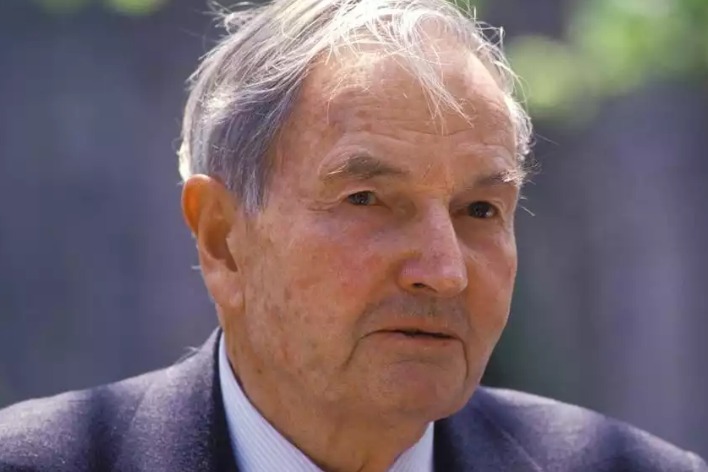
Philanthropist and Head of Chase Manhattan,David Rockefeller, Dies at 101


David Rockefeller, the banker and philanthropist with the fabled family name who controlled Chase Manhattan bank for more than a decade and wielded vast influence around the world even longer as he spread the gospel of American capitalism, died on Monday morning at his home in Pocantico Hills, N.Y. He was 101.
A family spokesman, Fraser P. Seitel, confirmed the death.


Chase Manhattan had long been known as the Rockefeller bank, though the family never owned more than 5 percent of its shares. But Mr. Rockefeller was more than a steward. As chairman and chief executive throughout the 1970s, he made it “David’s bank,” as many called it, expanding its operations internationally.
His stature was greater than any corporate title might convey, however. His influence was felt in Washington and foreign capitals, in the corridors of New York City government, art museums, great universities and public schools.
Mr. Rockefeller could well be the last of an increasingly less visible family to have cut so imposing a figure on the world stage. As a peripatetic advocate of the economic interests of the United States and of his own bank, he was a force in global financial affairs and in his country’s foreign policy. He was received in foreign capitals with the honors accorded a chief of state.
He was the last surviving grandson of John D. Rockefeller, the tycoon who founded the Standard Oil Company in the 19th century and built a fortune that made him America’s first billionaire and his family one of the richest and most powerful in the nation’s history.
As an heir to that legacy, Mr. Rockefeller lived all his life in baronial splendor and privilege, whether in Manhattan (as a boy he and his brothers would roller-skate along Fifth Avenue trailed by a limousine in case they grew tired) or at his magnificent country estates.
Imbued with the understated manners of the East Coast elite, he loomed large in the upper reaches of a New York social world of glittering black-tie galas. His philanthropy was monumental, and so was his art collection, a museumlike repository of some 15,000 pieces, many of them masterpieces, some lining the walls of his offices 56 floors above the streets at Rockefeller Center, to which he repaired, robust and active, well into his 90s.
In silent testimony to his power and reach was his Rolodex, a catalog of some 150,000 names of people he had met as a banker-statesman. It required a room of its own beside his office.
Spread out below that corporate aerie was a city he loved and influenced mightily. He was instrumental in rallying the private sector to help resolve New York City’s fiscal crisis in the mid-1970s. As chairman of the Museum of Modern Art for many years — his mother had helped found it in 1929 — he led an effort to encourage corporations to buy and display art in their office buildings and to subsidize local museums. And as chairman of the New York City Partnership, a coalition of business executives, he fostered innovation in public schools and the development of thousands of apartments for lower-income and middle-class families.
He was always aware of the mystique surrounding the Rockefeller name.
“I have never found it a hindrance,” he once said with typical reserve. “Obviously, there are times when I’m aware that I’m treated differently. There’s no question that having financial resources, which, thanks to my parents, I learned to use with some restraint and discretion, is a big advantage.”
Ambassador for Business
With his powerful name and his zeal for foreign travel — he was still traveling to Europe into his late 90s — Mr. Rockefeller was a formidable marketing force. In the 1970s his meetings with Anwar el-Sadat of Egypt, Leonid Brezhnev of the Soviet Union and Zhou Enlai of China helped Chase Manhattan become the first American bank with operations in those countries.
“Few people in this country have met as many leaders as I have,” he said.
Some faulted him for spending so much time abroad. He was accused of neglecting his responsibilities at Chase and failing to promote aggressive, visionary managers. Under his leadership Chase fell far behind its rival Citibank, then the nation’s largest bank, in assets and earnings. There were years when Chase had the most troubled loan portfolio among major American banks.
“In my judgment, he will not go down in history as a great banker,” John J. McCloy, a Rockefeller friend and himself a former Chase chairman, told The Associated Press in 1981. “He will go down as a real personality, as a distinguished and loyal member of the community.”
His forays into international politics also drew criticism, notably in 1979, when he and former Secretary of State Henry A. Kissinger persuaded President Jimmy Carter to admit the recently deposed shah of Iran into the United States for cancer treatment. The shah’s arrival in New York enraged revolutionary followers of the Ayatollah Ruhollah Khomeini, provoking them to seize the United States Embassy in Iran and hold American diplomats hostage for more than a year. Mr. Rockefeller was assailed as well for befriending autocratic foreign leaders in an effort to establish and extend his bank’s presence in their countries.
“He spent his life in the club of the ruling class and was loyal to members of the club, no matter what they did,” The New York Times columnist David Brooks wrote in 2002, citing the profitable deals Mr. Rockefeller had cut with “oil-rich dictators,” “Soviet party bosses” and “Chinese perpetrators of the Cultural Revolution.”
Still, presidents as ideologically different as Mr. Carter and Richard M. Nixon offered him the post of Treasury secretary. He turned them both down.
After the death in 1979 of his older brother Nelson A. Rockefeller, the former vice president and four-time governor of New York, David Rockefeller stood almost alone as the remaining family member with an outsize national profile. Only Jay Rockefeller, a great-grandson of John D. Rockefeller, had earned prominence as a governor and United States senator from West Virginia. No one from the family’s younger generations has attained or perhaps aspired to David Rockefeller’s stature.
“No one can step into his shoes,” Warren T. Lindquist, a longtime friend, told The Times in 1995, “not because they aren’t good, smart, talented people, but because it’s just a different world.”
A Privileged Life
The youngest of six siblings, David Rockefeller was born in Manhattan on June 12, 1915. His father, John D. Rockefeller Jr., the only son of the oil titan, devoted his life to philanthropy. His mother, Abby Aldrich Rockefeller, was the daughter of Nelson Aldrich, a wealthy senator from Rhode Island.
Besides Nelson, born in 1908, the other children were Abby, who was born in 1903 and died in 1976 after leading a private life; John D. Rockefeller III, who was born in 1906 and immersed himself in philanthropy until his death in an automobile accident in 1978; Laurance, born in 1910, who was an environmentalist and died in 2004; and Winthrop, born in 1912, who was governor of Arkansas and died in 1973.
David, the youngest, grew up in a mansion at 10 West 54th Street, the largest private residence in the city at the time. It bustled with valets, parlor maids, nurses and chambermaids. For dinner every night his father dressed in black tie and his mother in a formal gown.
Summers were spent at the 107-room Rockefeller “cottage” in Seal Harbor, Me., weekends at Kykuit, the family’s country compound north of the city in Tarrytown, N.Y. The estate was likened to a feudal fief. As Mr. Rockefeller wrote in his autobiography, “Memoirs” (2002), “Eventually the family accumulated about 3,400 acres that surrounded and included almost all of the little village of Pocantico Hills, where most of the residents worked for the family and lived in houses owned by Grandfather.”
In that bucolic setting he developed a fascination for insects that would lead to his building one of the largest beetle collections in the world.
David was 21 when John D. Rockefeller died. “He told amusing stories and sang little ditties,” Mr. Rockefeller recalled in 2002. “He gave us dimes.”
His sense of noblesse oblige was heightened by his early education at the experimental Lincoln School in Manhattan, founded by the American philosopher John Dewey and financed by the Rockefeller Foundation to bring together children from varied social backgrounds. He went on to study at Harvard, receiving his B.S. in 1936, and then spent a year at the London School of Economics, a hotbed of socialist intellectuals. Mr. Rockefeller was awarded a Ph.D in economics from the University of Chicago in 1940.
Moved by the Great Depression at home and abroad, he stated in his doctoral thesis that he was “inclined to agree with the New Deal that deficit financing during depressions, other things being equal, is a help to recovery.” The notion that a Rockefeller would take such a liberal economic view was major news; the family, rock-ribbed Republican, was known for its fierce opposition to President Franklin D. Roosevelt, the New Deal’s author.
After receiving his doctorate, Mr. Rockefeller became a secretary to Fiorello H. La Guardia, New York’s pugnacious, liberal Republican mayor. In 1940, he married Margaret McGrath, known as Peggy, whom he had met at a dance seven years earlier, when he was a Harvard freshman and she was a student at the Chapin School in New York. His wife, a dedicated conservationist, died at 80 in 1996. They had six children: David Jr., Abby, Neva, Margaret, Richard and Eileen. A complete list of his survivors was not immediately available.
Mr. Rockefeller enlisted in the Army in 1942, attended officer training school and served in North Africa and France in World War II. He was discharged a captain in 1945.
He began his banking career in 1946 as an assistant manager with the Chase National Bank, which merged in 1955 with the Bank of Manhattan Company to become Chase Manhattan. Banking in the early postwar era was a gentleman’s profession. Top executives could attend to outside interests, using social contacts to cultivate clients, while leaving day-to-day management to junior officers. Mr. Rockefeller found plenty of time for such activities. In the late 1940s he replaced his mother on the Museum of Modern Art’s board and eventually became its chairman. He courted art collectors. In 1968, he put together a syndicate, including his brother Nelson and the CBS chairman, William S. Paley, to buy Gertrude Stein’s collection of modern art. David and Peggy Rockefeller’s own prized paintings — by Cézanne, Gauguin, Matisse, Picasso — were lent to the museum permanently.
Expanding a Bank Globally
Mr. Rockefeller’s rise in banking was swift. By 1961 he was president of Chase Manhattan and its co-chief executive with George Champion, the chairman. Promoting expansion overseas, Mr. Rockefeller clashed with Mr. Champion, who thought that the bank’s domestic business was more important. After Mr. Rockefeller replaced Mr. Champion as chairman and sole chief executive in 1969, he was able to enlarge the bank’s presence on almost every continent. He said his brand of personal diplomacy, meeting with heads of state, was crucial in furthering Chase’s interests.
“There were many who claimed these activities were inappropriate and interfered with my bank responsibilities,” Mr. Rockefeller wrote in his autobiography. “I couldn’t disagree more.” His “so-called outside activities,” he insisted, “were of considerable benefit to the bank both financially and in terms of its prestige around the world.”
By 1976, Chase Manhattan’s international arm was contributing 80 percent of the bank’s $105 million in operating profit. But instead of vindicating Mr. Rockefeller’s avidity for banking abroad, those figures underlined Chase’s lagging performance at home. From 1974 to 1976 its earnings fell 36 percent, while those of its biggest rivals — Bank of America, Citibank, Manufacturers Hanover and J..P. Morgan — rose 12 to 31 percent.
The 1974 recession hammered Chase, which had an unusually large portfolio of loans in the depressed real estate industry. It also owned more New York-related securities than any other bank in the mid-1970s, when the city was edging toward bankruptcy. And among major banks, Chase had the largest portfolio of nonperforming loans.
Chase also got caught up in a scandal in 1974. An internal audit discovered that its bond trading account was overvalued by $34 million and that losses had been understated. A resulting $15 million drain in net income tarnished the bank’s image. In 1975, the Federal Reserve and the comptroller of the currency branded Chase a “problem” bank.
Even as he struggled to reverse Chase Manhattan’s decline, Mr. Rockefeller found time to address New York City’s financial problems. His involvement in municipal affairs dated to the early 1960s, when, as founder and chairman of the Downtown-Lower Manhattan Association, he recommended that a World Trade Center be built.
In 1961, largely at his instigation, Chase opened its 64-story headquarters in the Wall Street area, a huge investment that helped revitalize the financial district and encouraged the World Trade Center project to proceed.
In the mid-1970s, with New York City facing a default on its debts because of sluggish economic growth and uncontrolled municipal spending, Mr. Rockefeller helped bring together federal, state and city officials with New York business leaders to work out an economic plan that eventually pulled New York out of its crisis.
At the same time, he put his bank’s affairs in order. By 1981, he and his protégé Willard C. Butcher had restored Chase Manhattan to full health. He yielded his chairmanship to Mr. Butcher that year.
From 1976 to 1980, the bank’s earnings more than doubled, and it outperformed its archrival, Citibank, in returns on assets, a critical indicator of a bank’s profitability. Even after retiring from active management in 1981, Mr. Rockefeller continued to serve Chase as chairman of its international advisory council and to act as the bank’s foreign diplomat. He did not hesitate to criticize United States officials for policies he considered mistaken.
He was notably harsh about President Carter. In 1980 he told The Washington Post that Mr. Carter had not done “what most other countries do themselves, and expect us to do — namely, to make U.S. national interests our prime international objective.”
But Mr. Rockefeller also played the gadfly to Mr. Carter’s far more conservative successor, President Ronald Reagan. When the Reagan administration was supporting anti-Marxist guerrillas in Africa, Mr. Rockefeller took a 10-nation tour of the continent in 1982 and declared that African Marxism was not a threat to the United States or to American business interests.
Late in life Mr. Rockefeller was involved in controversies over Rockefeller Center, the Art Deco office building complex his father built in the 1930s. In 1985, the Rockefeller family mortgaged the property for $1.3 billion, pocketing an estimated $300 million. In 1989, the family sold 51 percent of the Rockefeller Group, which owned Rockefeller Center and other buildings, to the Mitsubishi Estate Company of Japan. Mitsubishi later increased its share to 80 percent.
The purchase marked the high tide of a buying spree of American properties by Japanese corporations, and it opened the family to criticism that it had surrendered an important national symbol to them. When Japan’s economic bubble burst in the early 1990s, and Mitsubishi was forced to declare Rockefeller Center in bankruptcy in 1995, Mr. Rockefeller was criticized again, this time for allowing the site to slip into financial ruin.
Before the year ended, Mr. Rockefeller had put together a syndicate that bought control of Rockefeller Center. Then, in 2000, it was sold in a $1.85 billion deal that severed the center’s last ties with the Rockefeller family.
As an octogenarian, Mr. Rockefeller, whose fortune was estimated in 2012 at $2.7 billion, increasingly devoted himself to philanthropy, donating tens of millions of dollars in particular to Harvard, the Museum of Modern Art and the Rockefeller University, which John D. Rockefeller Sr. founded in 1901.
Even in his 90s, Mr. Rockefeller continued to work at a pace that would tire a much younger person. He traveled more than half the year on behalf of Chase or groups like the Council on Foreign Relations and the Trilateral Commission. By 2005, when he was interviewed in his offices at Rockefeller Center, he had remained physically active, working with a trainer at the center’s sports club.
He continued to collect art, including hundreds of paintings as well as works in colored glass, porcelain, petrified wood and furniture.
That same year he pledged a $100 million bequest to the Museum of Modern Art. Such giving became grist for the society pages. One celebrity-filled fund-raising gala at the museum in 2005 drew 850 people paying as much as $90,000 for a table. The occasion was Mr. Rockefeller’s 90th birthday, and at the end of the evening he was presented with a birthday cake modeled after his house in Maine. Then it was off to a week in southern France to continue the celebration with 21 members of his family.
With the book “Memoirs” in 2002, he became, at age 87, the first in three generations of Rockefellers to publish an autobiography. Asked why he wrote it, he replied in his characteristic reserved tone, “Well, it just occurred to me that I had led a rather interesting life.”




RECENT POSTS

ad