A doctor has told the worried mother of a teenage girl that the young lady must lose her virginity via a medical procedure that is meant to correct her inability to menstruate.
The medical doctor, Chioma, on Twitter on Friday revealed how worried the mother was when she told her that her 17-year-old daughter needed a procedure that involved the breaking of her hymen.
The doctor, with Twitter handle @Deekachy_md, started the thread on Twitter, “So Dr, you want to disvirgin my 17yr old Daughter?”and she responded, “”Not really Ma, to treat, we have to break her Hymen. She has IMPERFORATE HYMEN. That’s why she hasn’t menstruated. Absence of Hymen doesn’t make her less a virgin, some are born without.”
Apparently, the teenager has what the doctor calls an “imperforate hymen, and needs the hymen to be broken so that the teenager could commence her menstrual period which appears to have been stalled by a lack of passage for blood to flow through.
“Madam, on examination, we discovered your daughter has an imperforate hymen. This means the hymen is blocking the vagina completely and so, nothing coming from up can come down, including her menses and Ovulation discharge, hence the fluid collection.”
And the mother’s response had been; “Why me? Doc what can cause this? What will people say? So this young girl will just lose her virginity like that?”
Mia Redworth was unprepared to see her postpartum body.
“After having my son I was very upset about my body,” the British mom, 22, tells IPRESTV. “My stomach looked like a popped balloon, I had dark purple stretch marks everywhere even though I used every cream possible to stop this during pregnancy. I was very naive because no one ever shows the truth.”
She continued: “It was a complete shock to see how a normal body looks after having a baby, and we never see this on Instagram or in the media. I felt very alone and couldn’t find anyone I could relate to.”
Not wanting other mothers to feel the same way, Redworth, whose son Austin is now 2, began posting unretouched photos of herself on social media as she began her fitness journey.
“It can be scary showing your true unedited self on a platform that glorifies Photoshop and surgery, but there have only been a few times I’ve had to deal with hateful people,” says Redworth, who gained more than 40 lbs. during pregnancy. “I’ve always received so much love and support. I think people are craving someone to be real.”
Redworth, who regularly posts her workouts — some involving her son — says she feels better now than she did pre-pregnancy.
“Before my pregnancy I was very unhealthy,” says the brand influencer, who has over 65,000 Instagram followers. “I was a size 4 (UK) and the only way I maintained that body size was to starve myself. During this time I absolutely hated my body, it wasn’t ever enough and I was never skinny enough. It definitely proves your weight has nothing to do with true happiness.”
Now, Redworth works out at the gym a few times w week and makes sure to drink at least 2 liters of water per day. She eats “clean and lean” homemade meals, but doesn’t deprive herself of anything. She also steers clear of any fad diets.
“I just want to be a good role model for Austin and show him that fitness and living healthy can be fun without having to restrict anything,” she says. “I have no desired dress size or weight, as numbers mean nothing — it’s all about how you feel. And I love my body as it is now.”
That includes every last inch. “I love my stretch marks and my c-section scar,” says Redworth. “I have truly embraced my whole self and I’ve never been happier with the way my body looks. Everyone has their own ‘imperfections’ and there’s nothing imperfect about them — they make us unique. They tell a story.”
Her message to other moms? “Don’t be so hard on yourself! You created a tiny human in your body, it’s going to look different,” she says. “We have all the time in the world to change our bodies, but we can’t let insecurities stop us from making memories with our children. Get in a bikini and go swimming!”
A banging hairdo is one way to kick off a good slay and we won’t even start to analyze how beautiful a properly done braid can make any woman. Nigerian women love to look good and they’d stop at nothing to achieve that proper look.
We have compiled a few braids that we know would suit you, if you’re beautiful and love to look chic. Check them out below and thank us later.
In the wake of allegations that Khloe Kardashian’s partner has cheated on her – numerous times – in the lead up to her giving birth to their first baby, Petria is sharing her story.
This is what it’s like to hold your newborn baby in your arms, with the knowledge the man you had her with has been sleeping with other women…
Petria was 18 when she met the man she would later pledge to be with forever. They were young – just teenagers – but both with an insatiable appetite for travel and adventure.
“I was quite young… to be honest, it was like any young romance – it’s not that we were young, dumb and stupid, but you do fall in love very quickly and move very fast,” the now 32-year-old tells Mamamia from her home in Brisbane.
Within a year of being together, they had moved overseas. Within two, they were married.
“We moved over to the UK within a year of being together. We spent two and a half years there and we just lived and worked and travelled.”
At the age of 20, she was married to a man she had known for two years. Her family, she says, were happy. They were happy if she was happy. But it was when they moved back home to Australia that everything changed.
“Within three months of being back in Australia, I was pregnant which was a bit of a surprise. A happy surprise, but a surprise. It was a total life changer.”
They were young, but they were excited. Baby Rhiana arrived when she was just 22. Four weeks later, she found out her ex-husband had been having an affair throughout the entirety of her pregnancy.
She found out in a way that, even today, isn't uncommon: The phone bills.
"You'll always remember [that moment], because it was so life changing and so heartbreaking. I was checking our phone bills and there was a lot of international texts to the lady. I immediately questioned it because I just couldn't understand, we didn't know anyone in South Africa. It turns out the lady was on holidays in South Africa.
"He denied it, like most instinctively do. [But] there was one person who was quite close to him, and I went straight to them. They confirmed it."
Petria's husband had been having sex with another woman while she was at home, carrying their baby in her belly.
More than one person in her ex-husband's immediate circle knew of the affair. No one went to Petria, at home with a four-week old baby, and told her about it.
"They thought it was a ticking time bomb, they knew it was going to come out at some point, they just didn't know when.
"As anyone who has been in a young relationship, I did think it was going to be forever. I still believe everything happens for a reason, that whatever happened at that time was meant to happen, and I don't regret anything I've done, but if my daughter told me she was getting married at 20... well, I wouldn't recommend it.
"I believed that I knew everything about him, and I did, to a point."
Despite her ex-husband's repeated denials, the couple immediately split. They sold the unit they lived and owned together and she went home to live with family.
"When we first separated, I felt it did taint my entire pregnancy, but that was just my initial grief. That was the first stage. Now, I don't feel like that about the pregnancy at all, but at the start it tainted it."
However, it influenced no part of her relationship with her daughter. If anything, their bond was "made much stronger", despite the fact that looking back, the affair - in her opinion - wasn't an isolated event.
Esther Perel tells Mia Freedman all about the psychology of cheating. Post continues after audio.
"I think in hindsight, you can pinpoint certain moments and other times it probably happened. I've never questioned it since, I just don't really want or need to know."
As for the affair that broke up their marriage, Petria says it was never formally confirmed on the behalf of her ex-husband. He, for the record, is still with the woman. They have their own children together.
"It was all basically confirmed when he... moved in with her soon after we split and when he was having visitation, he would bring her along.
"It's completely heartbreaking, I won't lie. It was definitely a horrible experience in my life, but as I said, everything happens for a reason. I have since re-married and I met [my husband] eight months after my split. I can see now that I was meant to go through through all of that to meet him."
After meeting her now-husband Ben through a mutual friend, Petria says it "took some time" and "a lot from [her] side" to trust someone again.
"As any person who goes through a breakup, it took a lot from my side to trust someone again. It takes a lot to build that trust back. But my husband now is totally the polar opposite to my ex-husband."
They've since had two children together - Lola who is three and Coco, aged one - and she and her ex-husband are, remarkably, on really good terms.
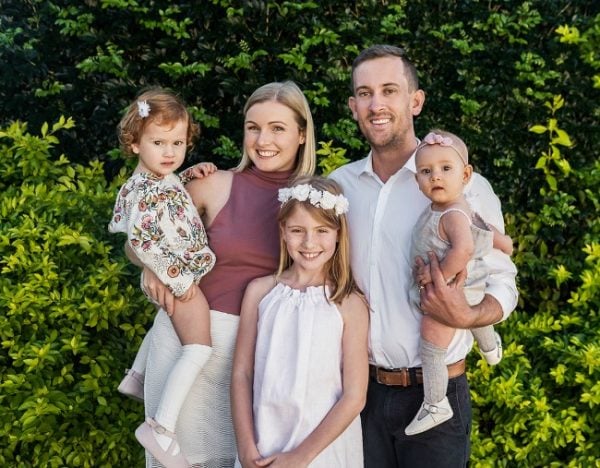
Petria and her husband, Ben, with their three children. Image: Supplied.
"Our relationship is so good and compared to what it used to be... we have taken some family holidays together. At the end of the day, it's important forgiveness happens on both sides because going through a divorce and splitting money and everything was quite toxic. But it's definitely good now. In fact, I definitely deal with [the other woman] now more than him. I have a good relationship [with her] now, though I would have never expected that.
"There was no actual ‘date’ as such when we realised that we were on better terms… both my ex husband and I had noticed increased co-operation, a more free-flowing exchange of communication and leniency once we both started having children of our own with our respective partners. I'm not sure if we realised there were more important things to consider than arguing over the little details or we both got too busy but our situation definitely calmed down from there on."
She said while their divorce was "very toxic" and she dealt with "some really painful emotions", the two have cultivated a relationship that's healthy and co operative and one her daughter can look up to.
"First and foremost the children need to be put ahead of either parent's own interest. If nothing else you both have an intense common love for your kids that you share, so keep focus on the greater good for them. If your ex partner gives a nice gesture, make sure it is acknowledged and return the favour.
"Never argue in front of your children and if need be, send carefully worded emails or messages in preference to discussions that can blow out into heated arguments. Start with small gestures and build trust. Have lots and lots of patience and most of all you'll both need to learn forgiveness. It's paramount in order to move forward. It probably took us six years to make any noticeable change."
No matter what, Petria stresses, bad things always have good outcomes. It might just take a while for them to surface.
"No matter what anyone goes through, there is always an outcome. If you've got the children as the main focus, the adults can learn to get over themselves. Rhiana's siblings just all think they're one big family, and if people can learn to forgive, then everyone is better off."
When facing off against bullies, some children and parents are going under the knife.
As was the case for 11-year-old Bella Harrington, who underwent pediatric cosmetic surgery in December because she says bullies at her school were tormenting her about her protruding ears.
“They would always point it out, but then the more people pointed it out is when I wanted to change it,” the Virginia pre-teen told local affiliate WRIC. “I thought that they stuck out way too much.”
Bella and her mother Sabrina made the decision to finally silence the bullies after years of considering the procedure, known as an otoplasty, which pins back the ears.
“When people would ask if I would like to go swimming in the summer I’d be scared they’d show,” Bella recalled about getting teased.
“They were being mean, saying different things,” Sabrina said. “One thing they said, she had elf ears.”
Bella Harrington. WRIC
Dr. Joe Niamtu, who practices in Midlothian, performed the surgery, calling it his “biggest reward” to help students like Bella.
“It was my honor to help this beautiful young lady to escape the effect of peer bullying from her protruding,” Dr. Niamtu said on Facebook. “Even small facial deformities can produce very negative psychological consequences in childhood that can lead to a lifetime of low self-esteem and negative body image. My biggest reward.”
In fact, he told WRIC that the younger the patient is the better the outcome and it is not uncommon for children as young as 4 years old to go under the knife.
“We like to treat these children before they enter school, so it’s not uncommon that I’m doing 4- or 5-year-olds,” Dr. Niamtu said, adding, “And the reason is bullying or peer pressure. It’s been shown to psychologically to have the ability to affect their self-esteem or body image for the rest of their life.”
Now two months after the surgery, both Bella and Sabrina are overwhelmed with the positive results.
“I was so happy,” the child said, remembering the first time she saw her new ears. These days, Bella puts her hair up often and is not “focused on if people can see” her ears.
“It’s no different than getting braces, that changes your appearance,” Sabrina said. “If it’s going to make you feel better about yourself, so be it.”
PCOS symptoms
At its heart, polycystic ovary syndrome (PCOS) is a hormonal imbalance. Specifically, women with PCOS have higher than normal levels of androgens or male hormones.
PCOS is usually thought of as a reproductive disorder; it affects 10% of women of childbearing age and usually starts after puberty. But some of its effects seem to have little to do with fertility.
“People can get multiple symptoms for multiple reasons,” says Karen Carlson, MD, assistant professor of obstetrics and gynecology at the University of Nebraska Medical Center. “PCOS is a syndrome with a spectrum of symptoms that you can get, but not everybody gets everything.” (And, of course, not everyone with some of these common symptoms has PCOS.)
Becoming familiar with the symptoms can mean earlier diagnosis and treatment, which in turn might help ward off some of the potential long-term complications of PCOS. Infertility isn’t the only concern–women with PCOS also have an increased risk of type 2 diabetes, high blood pressure, and endometrial cancer.
To be officially diagnosed with PCOS, you have to have at least two of three symptoms. Those are irregular periods, high levels of androgens, and ovaries with multiple cysts. But there are many other signs as well.
Irregular periods
Irregular periods are the most common sign of PCOS. For many women with PCOS, that means infrequent periods: For adults with the syndrome, periods typically occur at least 35 days apart. Adolescents wait at least 45 days between periods, says Jenny M. Jaque, MD, chief of obstetrics and gynecology at the University of Southern California's Keck School of Medicine.
But there can be large variations between individuals. “It could be once every few months, once every six months,” says Mitchell S. Kramer, MD, chairman of obstetrics and gynecology at Northwell Health’s Huntington Hospital in Huntington, New York.
Periods can also be heavier or lighter than expected, or you could have no periods at all, a condition called amenorrhea.
The reason for all of these irregularities is that you’re not ovulating, or not ovulating regularly. Unless you’re trying to get pregnant, this may seem like a minor issue–or maybe you even like not having your period every month–but not having regular periods can cause trouble down the line. “The longer you go without a period, cells can grow out of control and can become cancerous,” says Dr. Jaque.
With the goal of protecting the uterine lining from cancer, Dr. Jaque says, treatment involves getting ovulation going again. Sometimes diet and exercise modifications can do the trick; other times, birth control pills (if you don’t want to get pregnant) are needed. Some women are even treated with the diabetes drug metformin, which can help restart ovulation.
Don’t forget: Missed periods could also mean you’re pregnant, Dr. Jaque adds.
Out-of-whack hormones
The only way to know for sure that you have a hormonal imbalance signaling PCOS is to have a blood test done. Lab tests can also rule out other conditions that might be causing your symptoms, including things like thyroid problems or tumors.
While doctors will definitely notice something’s up on your blood work, Dr. Kramer says, no one test will give you a definitive diagnosis of PCOS. Instead, doctors rely on measurements of several different hormones. For instance, levels of testosterone and luteinizing hormone (which helps cue ovulation) may be high, while levels of estrogen may be normal or high. Follicle stimulating hormone will more than likely be normal or low.
Polycystic ovaries
There’s no way for you to know on your own if you have polycystic ovaries, but they can show up on imaging tests, usually an ultrasound. “The classic appearance of the ovaries [with PCOS] is they have these small cysts that are collected around the periphery,” says Dr. Kramer. “It almost looks like a string of pearls.”
Strangely enough, polycystic ovaries are not always a component of polycystic ovary disease. Many women don’t show ovarian cysts but get diagnosed with and treated for PCOS anyway. Other people have cysts yet exhibit few symptoms. “Women can be affected in different ways,” says Dr. Carlson.
Infertility
PCOS is one of the leading causes of infertility in women. “You’re not ovulating regularly, so it can be tough to get pregnant,” Dr. Kramer explains. But not impossible. In fact, most women with the condition can get pregnant, he adds.
Sometimes losing as little as 10 to 15 pounds will trigger ovulation and improve your odds of conception. (In fact, adopting healthier diet and exercise habits and losing weight can help ease many PCOS symptoms.) Women with PCOS may also use various fertility treatments, starting with clomiphene, which helps with ovulation. In vitro fertilization may be an option for some people when medications don’t help.
PCOS is only one possible explanation for infertility. Make sure you and your doctor rule out other causes as well.
Abnormal hair growth
Up to 70% of women with PCOS experience hirsutism, or unwanted hair growth that follows a male pattern. You might find hair appears on your chin, upper lip, or chest. The hair is usually dark and coarse and is caused by the extra male hormones circulating in your body.
However, don’t automatically assume that body hair is a sign of PCOS, as there are many other possible causes. “Hair allover could be based on ethnicity or what medications you’re using,” says Dr. Jaque. Hairy legs and arms are definitely not signs of PCOS, she adds.
Treatments include hormonal contraceptives, sometimes combined with spironolactone, which blocks androgen production or its effects on hair follicles.
Some women also opt for hair removal with electrolysis or lasers, though this usually needs to be done on a regular basis. Creams, like Vaniqa–specifically approved for getting rid of unwanted facial hair on women–can help, though not permanently.
Thinning hair
Instead of or along with male-pattern facial or body hair growth, some women with PCOS experience male-pattern baldness. It’s not all that common, but it can happen–and it can get worse in middle age.
“Women with PCOS can get more male-pattern baldness or thinning in the forehead area, especially if they’ve been untreated for a while,” says Dr. Carlson. “If you don’t get treatment and stop the [hair-thinning] process early, sometimes it isn’t reversible.”
Like other signs of PCOS, thinning hair is the result of hormones behaving abnormally. After trying lifestyle modifications, the go-to treatment is hormonal birth control.
Acne
Many women–and men!–have acne for plenty of other reasons. But with PCOS, women might find that acne is associated with irregular periods and can be especially tough to treat.
“Acne is not a criterion [to diagnose PCOS] because it is so common,” says R. Jeffrey Chang, MD, professor emeritus of reproductive medicine at the University of California San Diego. “Most of the people who have acne don’t have elevated testosterone.”
If acne is due to too much testosterone, once again, hormonal birth control can help, says Dr. Carlson. A dermatologist may also recommend topical treatments.
Obesity
About half of women with PCOS are obese. Extra fat, especially around the tummy area, can send your hormones further askew.
Women with PCOS who are overweight or obese also often have insulin resistance. Insulin normally moves sugar out of the bloodstream and into storage; insulin resistance is a loss of sensitivity to the hormone that causes higher than normal insulin levels in the blood. That can cause weight gain or make it harder to shed pounds, and it may also predispose you to diabetes.
High levels of insulin may also fuel production of more testosterone.
Of course, losing or maintaining a healthy weight is often easier said than done, but lifestyle changes are the first recommendation for people with PCOS, says Dr. Chang. “That means eating a diet that is healthy, not excessive in calories, accompanied by exercise,” he says. “Walking 30 minutes a day is good, as long as you make sure you get pushed a little bit.”
Other signs to watch for
Other symptoms can also be linked with PCOS, but the relationship isn’t as clear. For instance, some women report dark patches of skin especially along neck creases, under their breasts, or in the groin area, called acanthosis nigricans.
Women with PCOS may also be more prone to sleep apnea, along with higher “bad” LDL cholesterol and triglycerides and lower “good” HDL cholesterol. These are all components of metabolic syndrome, which also plagues women with PCOS.
Even skin tags have been linked with PCOS, but they could also be a result of obesity or aging, says Dr. Carlson.
Mood changes are another PCOS sign to look out for. This is more directly a result of hormones. “You’re almost in a constant state of PMS,” says Dr. Carlson. “A lot of women do get really moody, more so than normal.” Many women with PCOS also suffer from depression and anxiety and have a higher risk of eating disorders, notably binge eating and bulimia.
In the middle of reporting my book on death fraud, I got caught cheating on my boyfriend.
I'd been pursuing the question for years: can you disappear in the 21st century? I had interviewed dozens of devious characters—privacy consultants, fixers who forged death certificates, life-insurance fraudsters—and I thought they had taught me the most important thing about faking your death: how to cover your tracks. I just didn't know I would end up applying this lesson to my own illicit affair.
In my reporting, I had investigated all forms of digital footprints—IP addresses, pinging cell phones, surveillance cameras capturing your image at every turn. In accordance with what I had learned, I erased all the incriminating emails from my drafts, sent, and inbox folders. All but one, which blatantly outlined a plan for a rendezvous. I had deleted all call logs and texts. Except for those few phone calls I forgot about. Worst of all, I hadn't considered that you can still get busted in the most analog ways. So when my live-in boyfriend stumbled upon my most deranged lovelorn musings in a journal I had left out, it was evidence so anachronistic, so juvenile in its sloppiness, it hadn't occurred to me to better obscure it. Ink on paper was what tipped him off, spurring him to comb my phone and computer for traces of what else I'd left behind.
At this point in the story, armchair analysts will speculate that I wanted to get caught. Maybe in the grand cosmic scheme of things, some part of me did. My boyfriend and I had been together for six years and lived together for three. We shared a rating system based on New York City mayors ("Is this shirt Giuliani or Fooliani? Dinkins or Stinkins?") and had adopted a Jack Russell-Chihuahua mix. We'd both recently turned 30 and had vague plans for what our wedding might look like—a taco truck and lots of dancing—but no hard plans for when that might take place or what we envisioned for the future. We'd grown comfortably into something between friends, roommates, and canine co-parents, so deeply ensconced in each other's lives that imagining an alternative seemed impossible. But hurting the person I lived with for the happiest years of my life? Being thrown out of our home after he made his discovery? I had envisioned a slightly more graceful exit. The morning I left, the sun was just beginning to tinge the sky violet, and I walked away with our dog and a haphazardly packed suitcase of gym shorts and high heels.
For years, I had been interviewing men who had made great messes of their lives (pseudocide seems to be an almost universally male phenomenon—or maybe women do it just as much but don't get caught). Typically, when these guys get the idea to fake their deaths and then actually execute the plan, they are backed into a corner. They've cheated, they've lost millions of dollars of investor money, or they're attempting to shirk their debts to creditors by taking an easy way out. These are guys who make fools out of the family members who mourn them, who attempt to outsmart law-enforcement agents who are paid thousands of dollars of taxpayer money to search for bodies that never appear. And these guys often have a tidy excuse for why they've done it. I just couldn't get over the hubris it requires: to think that you can get what you want and get away with it at the same time.
* * *
I was at a writers' residency when I met him. He had been a favorite critic of mine for years, and I knew he lived nearby. I also knew he was married, and I had no other motive in mind (swear to goddess) when I shot him an email, asking for his literary insight. He drove over to the big white house that same afternoon, and we drank tea on the wraparound porch. The interview went well, my recorder and notebook out the whole time, though none of my notes made it into the book. He was, coincidentally, the precise demographic of the person most likely to fake his death: a middle-aged, middle-class, white, heterosexual man with a family. I felt pleased that I had met him, that I had made what might one day turn into a strong professional contact. I didn't think anything of it beyond that. A few days later, he emailed me and suggested a walk. When he led me out to a sun-dappled field at the height of fall foliage and asked if he could kiss me, I probably shouldn't have been taken aback. I had been naïve enough to think that we would just be friends, that he could be interested in me as a platonic and intellectual equal. I made some resolution in my mind that this could be a litmus test that would help me figure out how I really felt about my boyfriend. We kissed. Looking back, it's painfully obvious that simply setting up the experiment gave me the answer I needed.
So we commenced what was intended to be a contained, three-week fling—one that would run the course of my residency. For him, a midlife crisis with an unthreatening nobody who would make him feel important. For me, a wildly affirming seal of approval that this person, who I thought was so brilliant, also thought I was at least a little brilliant.
While we were sneaking around, I found myself thinking a lot about a question I'd been asking since I'd begun my book. Where is the best place to disappear? While you'd think that a town out in the boondocks could get you good and gone, really, it turned out that the likelihood of running into someone you know was that much greater. We were always looking for places to hide.
***
I often shook my head at the people I interviewed, men who not only faked their death but also often philandered, and here I was, doing the exact same thing. Our affair was supposed to expire when I returned to my life and to my boyfriend in the city. But it didn't. The writer and I continued to see each other whenever he had to come to town. Though my dalliance lasted only six weeks before I got busted, I never thought I'd be someone for whom commitment would be a problem. I considered myself an honest person, with integrity. Now I was seeing how quickly those categories can crumble, and how it didn't happen out of malice. It just happened, through human weakness and self-absorption that I'd previously condemned. I thought about a conversation I'd had with two private investigators in Manila, about the men they chased, men who faked their deaths because they had a girlfriend on the side, or a second family. "Why don't they just get a divorce?" I asked them. They joked that it was because the men were afraid of their wives. While I still contend that playing dead instead of dissolving a marriage is a bit extreme, I was beginning to understand. Inventing a new, separate self, while radical and deranged, is more appealing than confronting the mistakes the old self might have made.
What I had never been able to get my head around, though, is the way the fakers could compartmentalize their indiscretions. One father who had staged his death in a kayaking accident had determined that he didn't need to let his adult sons in on his plan because, as he explained to me, they were busy with their own lives and wouldn't miss him. Before I knew it, I was advancing the same rationalizations, a similar cockeyed logic to justify my cheating. I would be happier having this thing on the side, I thought, and also exceedingly guilty, so I would heap more affection onto my boyfriend. Everyone would benefit. How could I make out with another woman's husband? Simple. She was merely theoretical to me. A ghost. I absolved myself of responsibility in that department (save the pangs that popped up—serving Thanksgiving dinner to my family in our apartment, having drinks with my friends while constantly checking my phone for messages) more seamlessly than I felt comfortable with.
Keeping a secret always closes you in on yourself. But, as I had told the writer, I felt something expanding within me, too. I know now what it was. It was empathy. I saw for the first time how easy it is to continue making a mistake you know you are making. I could no longer look at the subjects in my book with the same derision. When I had gone astray, it closed off my relationship, but it eventually opened me up to a new honesty.
Privacy consultant Frank Ahearn had always called the death fakers who got caught "morons and idiots." I laughed along. But now I felt like both a moron and an idiot. "Learn from this," my boyfriend said when he told me to leave. I did learn. I learned just how hard it is to cover your tracks in the 21st century. I learned that I am not cut out for the sly skulking around that disappearing requires.
I also learned that you can hold two contradictory ideas in your head and that they don't cancel each other out. I loved my boyfriend. I felt love for the writer, too, or something like it. I wish I had stayed. I'm glad I got caught. And I didn't toggle between these ideas. I held them simultaneously.
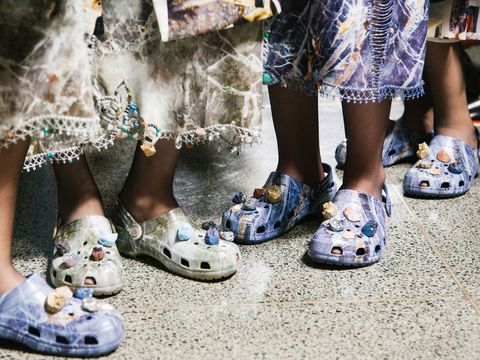
The spring/summer 2018 collections introduced the fashion circuit to the year's most unlikely "It" shoe—the Croc. And the divisive shoe has finally been given the ultimate stamp of approval.
Christopher Kane first hinted that the rubber sandals were making a comeback, when he debuted rock-emblazoned Crocs at his spring/summer 2017 show.
Christopher Kane made the case for Crocs at his spring/summer 2017 show Getty ImagesCourtesy of Crocs
But it was Demna Gvasalia for Balenciaga which sealed the deal, as the designer introduced the FROW to a child-like take on the sandal.
And the 10cm "Foam" platform shoes have already proven to be a massive hit with fans after managing to sell out online before they were even officially released.
The Balenciaga shoes became available to pre-order on the Barneys website for a cool $850 on February 1, 2018, but sold out within a matter of hours. Tough luck for those hoping to bag a pair ahead of the next wave of fashion week shows...
And it's an impressive sale for the shoe once dubbed the "dad sandal," but the soar in interest further proves Gvasalia's sartorial pulling power.
And with everything from the label's '80s-inspired spandex leggings, to Ikea-inspired accessories, there's no telling what the designer will convince the millennial set to buy next.
We all love to wear nail art on our long nails, but when our nails are constantly dipped in nail polish and other chemicals, it is highly likely that they become brittle and prone to breakage. This can hurt a lot especially when you snag your nails on your clothes. What’s more, when your nails become brittle, it wouldn’t be easy to grow them long since they will split eventually. Fortunately, you can correct this problem with the help of nail strengthening solutions that you can do on your own. Here are two recipes that you can use to give your nails the extra boost they need.
Honey and olive oil solution
This recipe calls for ¼ cup of olive oil, 1 tablespoon of lemon juice, medium-sized heatproof bowl and spoon, 1 tablespoon of honey, and 1 teaspoon of sea salt. What makes these ingredients appropriate for the job is because olive oil is high in vitamin E content which can assist in repairing and strengthening the nails. It is also useful in making your nails healthy and properly moisturized. Lemon juice, on the other hand, contains citric acid that can make your nails brighter. When applied on the nails, it will whiten dull and yellowish nails easily. Another plus to using lemon juice is that it can help strengthen the surface of the nails so that they don’t break easily. Sea salt is a useful ingredient because it can exfoliate your nails while deeply cleansing them so that they will be stronger and brighter. To make this recipe, simply put the olive oil, salt, honey, and lemon juice in a heatproof bowl and mix them thoroughly. Get a pan then add a few inches of water then place on top of the stove over medium low flame. Place the bowl on top of the pan then let the nail strengthener mix to warm up. The water should be low so that it doesn’t get inside the mixture. Once the solution has warmed up, remove from the pan and set it on the table. Dip your nails into the solution and let them soak for about 10 to 15 minutes. Scrub your nails afterward with a nail brush and soapy water to reveal shiny nails.
Olive oil and lemon juice
In this recipe, you will need 3 tablespoons of olive oil and 1 tablespoon of lemon juice. Olive oil is considered as an age old remedy when it comes to strengthening nails. Combining it with lemon juice makes this solution even better because of its acidic nature that can brighten your nails. Combine the two ingredients in a small bowl then pop into the microwave. Heat it up for 10 to 15 seconds until the mixture is warm to the touch. Remove from the microwave then stir. Use a clean cotton swab to apply the nail strengthener. Make sure that you cover the entire nail bed as well as the surrounding cuticles with the nail strengthener. You should also apply some on the underside of the nails too. You need to do this treatment every night before bed time to let the solution soak thoroughly. Cover your hands afterwards to prevent the mixture from staining your bed.
These nail strengthening solutions are perfect for those times when your nails are brittle. Soaking your nails in these solutions can deliver important nutrients in them so that they will grow healthy and strong. You should repeat these treatments regularly until you see some signs of improvement. For sure, you will love the new nails in no time.