ad

Showing posts with label science. Show all posts

The Color Dictionary Darwin Used to Describe the Natural World, Pre-Pantone


Today, naturalists who want to capture the precise color of a certain specimen can rely on color photography, safe in the knowledge that the hues can be preserved for exact recreation or reference. But in centuries past, naturalists and others working out in the field would consult a color dictionary—a sort of pre-Pantone reference guide—to accurately describe a specimen they were sketching. That way, even if the color of the drawing might fade, the shade from the shared nomenclature of colors would remain as a guide for illustrators recreating the image back home.


One of the most famous and widely used color guides was Patrick Syme’s Werner’s Nomenclature of Colors, first published in 1814 and recently reissued by Smithsonian Books. Abraham Gottlob Werner was a German geologist who, toward the end of his long and distinguished career, threw himself into creating a new color dictionary with which to describe the cornucopia of hues found in rocks and minerals. Scottish botanical artist Patrick Syme was entranced by Werner’s work, which had been published at the end of the 18th century, and felt he could improve it further by adding painted color swatches—Werner used only written descriptions—and examples from flora and fauna alongside the mineral comparisons.
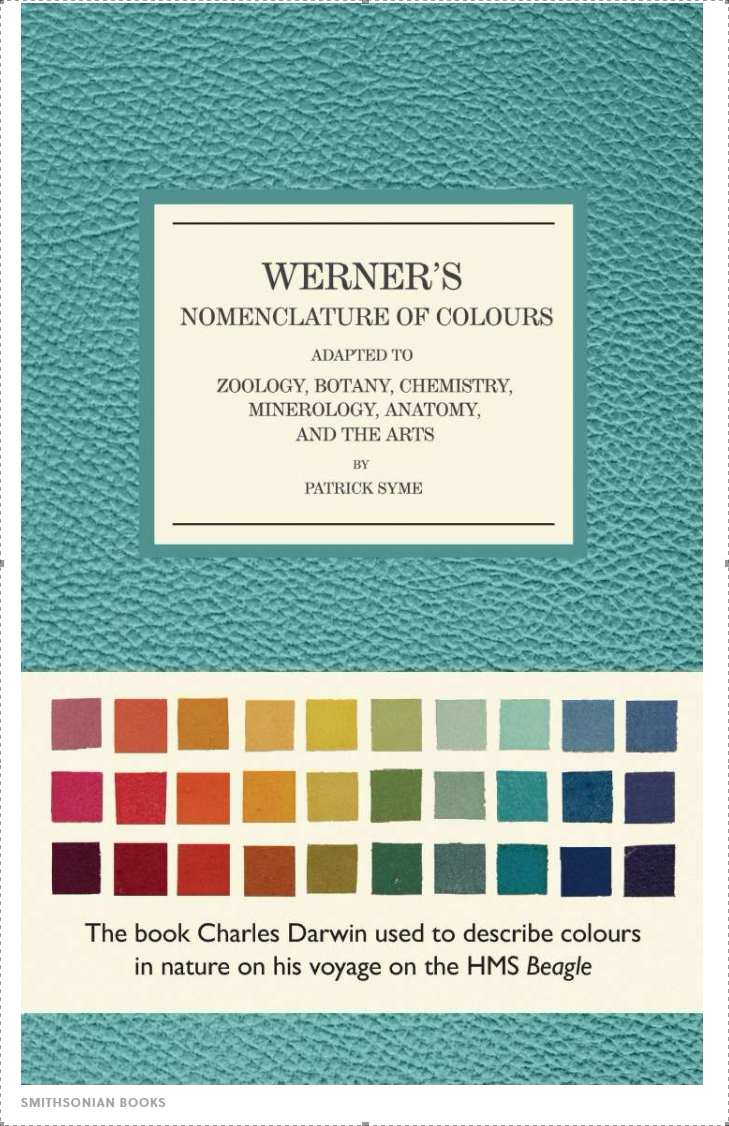


Not all colors received an example from each kingdom in Syme's work, but many did. For example, brownish orange was noted as existing in “the eyes of the largest flesh-fly,” the “style of the orange lily,” or in “dark Brazillian topaz.” Blueish green was recorded as existing in “egg of thrush,” “under disk of wild rose leaves,” and the mineral beryl. Ash gray was to be seen in the “breast of long-tailed Hen Titmouse,” “Fresh Wood ashes,” and “Flint." Syme ultimately created a reference work of 110 named colors, providing a whole new language with which to portray nature.

It was Werner’s Nomenclature of Colors that Charles Darwin took on his round-the-world voyage on the HMS Beagle from 1831–36. During the trip, Darwin spent a great deal of time collecting and recording natural history specimens, many of which would be dried and pressed or pickled in vinegar for preservation—processes that often caused the true colors to fade. Darwin consulted Werner’s Nomenclature frequently, confiding in fish expert Leonard Jenyns that “a comparison was always made with the book in hand, previous to the exact color in any case being noted.” Darwin’s written descriptions of the animals and plants he encountered are littered with color terms from the book, as when he describes the shades pulsating across the body of a cuttlefish as "varying in tint between a hyacinth red and a chestnut brown.”


It was not only the specimens that Darwin described using the color dictionary, but also the ever-changing hues of the sea. On March 28, 1832 he wrote, “During this day the colour of sea varied, being sometimes black ‘Indigo blue’, in evening very green.” Numerous other naturalists, such as Arctic explorer Sir William Edward Parry, botanist Sir William Hooker, and explorer and naturalist Sir John Richardson, also used Werner’s Nomenclature to standardize their description of color, with the evocative names like Orpiment Orange, Verditer Blue, and Gallstone Yellow adding a certain poetry to an otherwise functional description.

The reissue from Smithsonian Books recreates Syme's work in CMYK printing, bringing new vibrancy to the original and sometimes-faded shades. The book provides modern readers with an exploration of color through the eyes of 19th-century naturalists, whose perception of each hue would have been informed by the natural world around them. The lyrical descriptions offer a now-almost-forgotten language for color—less useful, perhaps, than a Pantone number, but a little more evocative.


This Man plan to Launch Himself in a Homemade Rocket to Prove the Earth Is Flat...This is some crazy sh*t


Seeking to prove that a conspiracy of astronauts fabricated the shape of Earth, a California man intends to launch himself 1,800 feet (549 metres) high on Saturday in a rocket he built from scrap metal.

Assuming the 500-mph (805-kmh), mile-long (1.6 km-long) flight through the Mojave Desert does not kill him, Mike Hughes told the Associated Press, his journey into the atmosflat will mark the first phase of his ambitious flat-Earth space program.
Hughes's ultimate goal is a subsequent launch that puts him miles above Earth, where the 61-year-old limousine driver hopes to photograph proof of the disc we all live on.
"It'll shut the door on this ball earth," Hughes said in a fundraising interview with a flat-Earth group for Saturday's flight.
Theories discussed during the interview included NASA being controlled by round-Earth Freemasons and Elon Musk making fake rockets from blimps.
Hughes promised the flat-Earth community that he would expose the conspiracy with his steam-powered rocket, which will launch from a heavily modified mobile home - though he acknowledged that he still had much to learn about rocket science.
"This whole tech thing," he said in the June interview. "I'm really behind the eight ball."
That said, Hughes isn't a totally unproven engineer. He set a Guinness World Record in 2002 for a limousine jump, according to Ars Technica, and has been building rockets for years, albeit with mixed results.
"Okay, Waldo. 3 . . . 2 . . . 1!" someone yells in a test fire video from 2012.
There's a brief hiss of boiling water, then . . . nothing. So Hughes walks up to the engine and pokes it with a stick, at which point a thick cloud of steam belches out toward the camera.
He built his first manned rocket in 2014, the Associated Press reported, and managed to fly a quarter-mile (0.4 km) over Winkelman, Ariz.
As seen in a YouTube video, the flight ended with Hughes being dragged, moaning from the remains of the rocket. The injuries he suffered put him in a walker for two weeks, he said.
And the 2014 flight was only a quarter of the distance of Saturday's mile-long (1.6 km-long) attempt.
And it was based on round-Earth technology.
Hughes only recently converted to flat-Eartherism, after struggling for months to raise funds for his follow-up flight over the Mojave.
It was originally scheduled for early 2016 in a Kickstarter campaign - "From Garage to Outer Space!" - that mentioned nothing about Illuminati astronauts, and was themed after a NASCAR event.
"We want to do this and basically thumb our noses at all these billionaires trying to do this," Hughes said, standing in his Apple Valley, California, living room, which he had plastered with drawings of his rockets.
"They have not put a man in space yet," Hughes said. "There are 20 different space agencies here in America, and I'm the last person that's put a man in a rocket and launched it."
He compared himself to Evel Knievel, as he promised to launch himself from a California racetrack - the first step on his steam-powered leap toward space.

The Kickstarter raised US$310 of its US$150,000 goal.
Hughes made other pitches, including a plan to fly over Texas in a "SkyLimo." But he complained to Ars Technica last year about the difficulty of funding his dreams on a chauffeur's meager salary.
A year later, he called into a flat-Earth community Web show to announce that he had become a recent convert.
"We were kind of looking for new sponsors for this. And I'm a believer in the flat Earth," Hughes said. "I researched it for several months."
The host sounded impressed. Hughes had actually flown in a rocket, he noted, whereas astronauts were merely paid actors performing in front of a CGI globe.
"John Glenn and Neil Armstrong are Freemasons," Hughes agreed. "Once you understand that, you understand the roots of the deception."
The host talked of "Elon Musk's fake reality," and Hughes talked of "anti-Christ, Illuminati stuff".
After half an hour of this, the host told his 300-some listeners to back Hughes's exploration of space.
While there is no one hypothesis for what the flat Earth is supposed to look like, many believers envision a flat disc ringed by sea ice, which naturally holds the oceans in.
What's beyond the sea ice, if anything, remains to be discovered.
"We need an individual who's not compromised by the government," the host told Hughes. "And you could be that man."

A flat-Earth GoFundMe subsequently raised nearly US$8,000 for Hughes.
By November, the AP reported, his US$20,000 rocket had a fancy coat of Rust-Oleum paint and "RESEARCH FLAT EARTH" inscribed on the side.
While his flat-Earth friends helped him finally get the thing built, the AP reported, Hughes will be making adjustments right up to Saturday's launch.
He won't be able to test the rocket before he climbs inside and attempts to steam himself at 500 mph (805 kmh) across a mile (1.6 km) of desert air. And even if it's a success, he's promised his backers an even riskier launch within the next year, into the space above the disc.
"It's scary as hell," Hughes told the AP. "But none of us are getting out of this world alive."
This is true. Yet some will try to live to see its edges.
2017 © The Washington Post
This article was originally published by The Washington Post.


Science Reveals that To Be Truly Happy, You Always Need This


"You always want what you can't have" is a phrase most often repeated by people trying to make a point that you should be satisfied with what you already have, rather than trying to attain more for fulfillment. After all, if you're just looking to the next big thing, you'll miss what's right in front of your eyes ... or so every romantic comedy ever has taught us.
Turns out, those people are wrong, at least to some extent. 
Studies have shown that it's not actually the achievement of goals that drives people onward — it's the desire to seek out bigger and better things. Turns out, wanting what you can't have might actually be the goal to a happier life.
How many times have you been told "no," "you can't," or that you aren't allowed to do something? When we're children, a natural reaction to this is a temper tantrum — arms flailing, lungs emptying, eyes leaking tears. We want to do whatever they won't allow us.
But when you're older, you find ways to deal with these upsets discreetly. A teenager might sneak out after curfew; a young adult might just ignore all rationality and do what they're told not to do anyway, which is why no one likes to hear "I told you so."
Learning consequences from our actions — and gaining wisdom from experience after we've messed up — is something that's bred into us from a young age. But as you grow, so does your need to explore and understand the world around you. And being told that you can't have something just makes it that much more desirable.
Why? Because it's sparked a little something within you called curiosity. And once your brain latches onto that urge, it's hard to get it to let go.
Curiosity is the single part of the human brain that propels us forward. It's what makes us choose things for ourselves — both stupid and incredibly smart — and guides us to new discoveries in personal and professional aspects of our lives. It's also what gives us the animalistic desire to follow said curiosity down whatever dark alleyway it leads us.
According to Jack Panskepp, the author of Affective Neuroscience, the reason that people keep exploring and trying to experience everything life has to offer is because it's bred into our very DNA. Every mammal has the same need to seek out circumstances in their environment and explore whatever will make their chances of survival better. Since it's linked to our reward-pleasure centers, your brain actually rewards you for pursuing whatever you're curious about.
So, wanting to get to know a new person, getting that job promotion, finding new music or exploring different areas of the world is actually so you can feel the thrill of the hunt, not the completion of a task. It's why putting the puzzle together feels better than staring at it when it's all done.
When you've reached your goal, it's over. But in the process of achieving it, you feel the happiest.
Pursuing the next big thing in your life can actually make you happier, because you're moving forward and striving to attain something. In our very goal-oriented and reward-focused brains, that's the thing that keeps us smiling.
The need to quest and pursue things in our lives is a natural human inclination, but can often come with unsavory consequences. Wanting more, desiring a better outcome, and trying to make things more beneficial for you is actually more rewarding than achieving those desires.
This is the same reason that people who win the lottery can be content playing for nothing after years, but don't gain any happiness once they've actually won that big jackpot. This is why it's important to balance curiosity with common sense.
Knowing that something isn't attainable because it might be detrimental to your health, circumstances, or psyche is far different than thinking you can'tdo something and working harder to achieve it. It's the difference between wanting a married man because you can't have him or deciding to train and run that 5K you've been talking about forever. One is obviously better for you than the other, but your brain still wants them both equally, and knowing a man is married might actually make him more attractive to you for this very same reason.
So, as it turns out, the key to a happier life is pursuing the things that will make you happy and are also healthy for you. Setting and achieving goals is a good thing in your life; find what piques your curiosity and use it to make your life better.
Go ahead and dream, pine away for more wealth, better relationships, or a sexy partner. Accomplish goals that you'd never even imagined, and explore every bit of the world. Work to achieve those things and then reap the rewards from your efforts.
Just make sure in the pursuit of your own happiness that you're not ignoring common sense to trample on someone else's.


There Is A secret message SpaceX sent to space aboard the cosmic Tesla and Elon Musk just revealed it


Elon Musk is always one for a nice surprise. 


Just after SpaceX launched the first flight of its Falcon Heavy rocket on Tuesday, lofting a red Tesla Roadster to deep space, Musk revealed a little secret hidden within the cosmic car. 
Musk posted a photo on Instagram displaying a message for any space-faring civilization that may come across the car in the future. The words "made on Earth by humans" are printed on the Tesla's circuit board.
The Tesla also comes equipped with a dashboard message reading "don't panic," and a dummy driver named "Starman" who will fly through the solar system in the Tesla for millions, if not billions, of years to come. 


This is far from the first time humans have sent a signpost of our existence out into the universe. 
NASA's two Voyager spacecraft are each carrying a Golden Record, which includes the sounds of Earth as well as a map that explains where we are in space. 
Basically, Starman is in good company. 
The Falcon Heavy — SpaceX's most powerful rocket ever — took flight at 3:45 p.m. ET from Kennedy Space Center. 
The huge rocket is basically three Falcon 9 rockets strapped together and can bring heavy payloads to distant parts of space like the moon or Mars. 
The key to the Falcon Heavy's success will be its reusability. SpaceX hopes to bring back the rocket's three first-stage boosters to Earth after launch, meaning they can use them again for later flights. 
The two side boosters made it back to the landing zones at Kennedy, but SpaceX has yet to reveal the fate of the third booster, which was expected to land on a drone ship in the Atlantic Ocean.


Photos: Man Who Builds Bicycle That Rides On Water Launches It On The Sea

A few months ago, YEN.com.gh had an encounter with a young Ghanaian inventor, Frank Darko, who had created a bicycle that could move on water.
He revealed that his invention started in August last year and with a lot of effort and hard work, he managed to finish his creation and tested it in a shallow dam in his area.
Now, the young inventor believing in his finished work, decided to test it out on the sea to prove to the world that his invention had come to stay.
In the many pictures that the young man sent to YEN.com.gh, some people were seen taking turns to experience the unique invention.
Speaking in a telephone conversation with YEN.com.gh, Frank Darko revealed that he wanted his invention to help the school children who had to swim to school, find an easier path to their classes.
This fact notwithstanding, he revealed that many individuals have also requested to have him make a copy of the bicycle for them.
He said he wanted to contribute to the development of Ghana with his invention. He however called on stakeholders and benevolent bodies to invest in his breakthrough invention so as to make the lives of many Ghanaians easy.
Frank Darko resides in Takoradi in the Western Region. He was a final year student at the Takoradi Technical University formerly known as Takoradi Polytechnic pursing a course in Graphic Design but deferred in his final year in school due to personal reasons.
The young inventor revealed that the special bicycle is his first invention but he had drawn up plans for many more inventions.
Frank Darko reached out to YEN.com.gh earlier and shared his amazing story and remarkable invention with us. This time, he took out his invention to do a daring test and also shared images with us.
He revealed that his creativity came about as a result of his matchless love for science, technology and the urge to solve day-to-day problems faced by people living in the community.


scientists finally reveals the origin of Gold, Platinum


Chances are you own something made of gold: a wedding band, a necklace, or a keepsake handed down from your great-great-grandmother. Maybe you’re even wearing it right now. But did you ever stop to think about where it came from?

Scientists have been pondering that question for decades—and now we know the fascinating answer: From the collision of two neutron stars 200 million years ago.

The collision sent a ripple through space that was observed early Sunday morning by the Laser Interferometer Gravitational-Wave Observatory (LIGO), the scientific collective whose founders won the Nobel Prize in Physics earlier this month. The group announced that event has revealed the origin of some of the heaviest elements on the periodic table. Included in that list: gold, platinum, and iodine—which is essential for human life.


But the truly exciting thing about the discovery, explains Duncan Brown, a LIGO member and a Syracuse University physicist at the heart of this discovery, is that it provides clues about the origin of the universe and the structure of matter. “This is a major advancement in human knowledge,” he tells Fortune.

Brown believes the neutron star collision may also help shed light on the prevailing theory of the formation of the universe—colloquially known as the “Big Bang” theory: That all matter was once collected into a single incredibly dense point and that that point “exploded” about 13,600 million years ago, creating the universe as we know it.

One of the key ways in which scientists have been trying to learn more about the Big Bang is by observing other explosions and collisions of celestial objects. Until now, LIGO had observed only four such collisions (which cause gravitational “ripples” in space making them ripe for detection); all of them have involved black holes.

But the problem with black holes is that, well, they’re black—and don’t really leave much to observe, Brown explains. The collision that scientists observed Sunday morning, however, “created a pretty spectacular display,” giving scientists insight into the formation of those heavy elements (gold and platinum included) and plenty of fodder to keep working towards the ultimate goal: Figuring out how we all got her


Men with Beards Are Better Boyfriend Material - Science

Bearded fellas everywhere, step forth! For you, my fuzzy-faced friends, have been lauded long-term relationship gold. Science says so.

The science-backed conclusion comes courtesy of a study, led by Barnaby Dixson and published in the Journal of Evolutionary Biology, that determined that dudes facially drowning in the furry stuff were more likely to be considered long-term relationship material compared to their fur-free equivalent.


"But how?! But why?!" I hear you ask, confusedly, as you mentally calculate the time it'll take your beau to produce some chin grass. A bodacious beard straddles the line of masculinity and femininity and, essentially, alters the face shape of a fella; thus rendering him ALL SORTS of attractive because, apparently, us ladyfolk don't like our dudes too masculine or feminine.

Add to that the idea that facial hair indicates testosterone and testosterone indicates maturity and, according to the study, you've got a recipe for sweet relationship success.


Now you're probably thinking: "OK, sure, I kinda get that. But what about if beneath the bountiful beard lay a jawline so sharp it could cut glass? What a travesty to mask such a thing!" Well, Barnaby's got an answer for that, too.

While the thought of Harry Styles' razor-sharp chops might get us going, an impeccable jowl suggests they'll fall short of relationship material. Instead, these types of hunks are limited to short-term dalliances and saucy one-nighters because we associate masculine features with unreliable suitors. (Although I think I speak for all of us when I say that I wouldn't dismiss a long-term relationship with Douglas Booth on the basis of his exceptionally-angled face.)


In other words: a full-blown beard has the ability to mask a masculine face - a face we'd otherwise only consider for a short-term relationship - or balance out a feminine face - a face we might not deem 'masculine' enough for a long-term relationship; hitting that elusive attractiveness 'sweet spot'.

Of 8,520 women asked, a mind-blowing 8,520 women (all of them, then) showed a preference for facial hair when asked to rate men (both with and without facial hair) out of six on attractiveness and on a spectrum of 'relationship longevity'. That's pretty conclusive, non? Guys with bountiful beards were considered more for marriage, while guys with little-to-no scruff were generally considered casual relationship material.

So, there you have it! Bag yourself a beard if you've got marriage in mind anytime soon. (And invite us, yeah?)


Olive Oil Ingredient Prevents Brain Cancer Growth In Lab Test

To the list of excellent reasons to use olive oil, we can add this one: it may be an effective preventative against brain cancer.

We already know olive oil is well worth adding to your diet for better heart health. It’s been shown to decrease arterial inflammation, lower blood pressure and contribute to weight loss when part of a Mediterranean-style diet. Previous studies have also shown potential for broader disease prevention, but the latest study went a step further in showing how oleic acid, olive oil’s main monounsaturated fatty acid, stops cancer-causing protein activity in brain cells.


Researchers found that the fatty acid inhibits the activity of a cell protein called Musashi homolog2, which in turn prevents the protein from stopping the production of a microRNA called miR-7 that suppresses brain tumor formation. In other words, oleic acid empowers miR-7 to do its job of preventing tumors by thwarting its nemesis protein, Musashi homolog2.


That’s the good news. The less good news is we still don’t know if dietary intake of olive oil provides this benefit. The claim may very well be proven out eventually, but testing it was beyond the bounds of this study. What this study does do, however, is provide the lab-tested basis for taking the necessary next steps to find out.


Quoting lead researcher Dr. Gracjan Michlewski, “While we cannot yet say that olive oil in the diet helps prevent brain cancer, our findings do suggest that oleic acid can support the production of tumor-suppressing molecules in cells grown in the lab. Further studies could help determine the role that olive oil might have in brain health."

80,000 cases of brain cancer are diagnosed every year in the U.S., and one third of those cases involve malignant tumors. Nearly 700,000 people in the U.S. are living with a primary brain and central nervous system tumor, according to the American Brain Tumor Foundation. Brain cancer is also the main cause of cancer-related deaths for children under age 14.

So if you’re already using olive oil, there’s ample reason to continue doing so for well-evidenced health benefits, and now possibly another big one. And if you aren’t, consider looking into the many reasons to begin working olive oil into your diet.

The study was published in the Journal of Molecular Biology.


Science Reveals How The Most Attractive Female Lips Look Like


In the age of the selfie, more women than ever are looking for ways to perfect their pouts—which might be why a record-breaking 27,400 lip implants were performed in the United States in 2015. But what does the "perfect" pair of female lips really look like? According to new research published in JAMA Facial Plastic Surgery, they're (mostly) more natural-looking than you might think.

In their February 2017 study, researchers from University of California, Irvine showed more than 400 participants side-by-side images of young women's lips and asked them to rank each photo on a scale of one to 10, with one being the least attractive and 10 being the most attractive.


First, the participants were shown photos in which women's overall lip sizes were manipulated, to help researchers gauge the "ideal" lip surface area: 


And then they were shown photos in which women's upper and lower lips were manipulated separately, to help researchers gauge the "perfect" upper-to-lower lip ratio:


Ultimately, the researchers found that participants preferred lips that were approximately 50 percent larger than a woman's natural lip size and took up about 10 percent of the lower third of a woman's face. They also preferred a lower lip that was two times the size of the upper lip—kind of like those of models Miranda Kerr and Alessandra Ambrosio, explained study co-author Natalie Popenko.


Models Miranda Kerr and Alessandra Ambrosio have lips that match study participants' preferences.

The participants' preference for a fuller, more natural lower lip was slightly surprising to the researchers, as current plastic surgery trends indicate that many women (celebrities and otherwise) are asking plastic surgeons for a visibly fuller upper lip. But the researchers recommend skipping the trend and preserving the more natural look if you do decide to have plastic surgery—a larger upper lip can unintentionally come off looking "overly filled and disproportionate," says study co-author Brian Wong, MD, PhD.

It's important to note that, in an effort to generate findings that could be compared to previous research, this study focused solely on the lips of young Caucasian women. And, of course, your lips—much less this study's definition of "perfect" ones—aren't the only things that define you and your beauty. So don't stress too much if your pout doesn't match these participants' preferences.

"Whole faces are greater than the sum of their parts, and attractiveness can also be defined by unique facial features," Popenko added.

[h/t TODAY]

From: Dr. Oz The Good Life


According to Science These Are The 10 Most Beautiful Women in the World


Science has been able to tell us a lot about beauty: the six physical features men can't resist, your most memorable facial feature, and now—which women are considered the most beautiful in the world and why.

It all comes down to an ancient Greek philosophy called the Phi ratio, which Julian De Silva, M.D., of the Centre for Advanced Facial Cosmetic and Plastic Surgery used along with computer facial mapping to determine which famous women have the ideal face ratio and symmetry.

While standards of beauty vary by culture, the ratio method is an interesting approach to aesthetics and may give us some clues as to why some people stand out more than others.

Amber Heard came in at the top of the list with a facial symmetry of 91.85 percent, while Helen Mirren ranked at #6 and Marilyn Monroe came in at #9. 


Dr. De Silva pointed out that this study is by no means a way to pit women against each other. "With this ground-breaking technology, we have solved some of the mysteries of what it is that makes someone physically beautiful," he said. "The results were startling and showed several famous actresses and models have facial features that come close to the ancient Greek principles for perfection."

So, according to the ancient Greeks and science, here are the 10 most beautiful women in the world:

1. Amber Heard 91.85%
2. Kim Kardashian 91.39%
3. Kate Moss 91.06%
4. Emily Ratajkowski 90.8%
5. Kendall Jenner 90.18%
6. Helen Mirren 89.93%
7. Scarlett Johansson 89.82%
8. Selena Gomez 89.57%
9. Marilyn Monroe 89.41%
10. Jennifer Lawrence 89.24%
(h/t Brit.Co)
From: Woman's Day


Science Just Reported That Women Who Are Surrounded By Nature Lives Longer


According to a new study published in Environmental Health Perspectives, American women who live in homes surrounded by more vegetation have significantly lower mortality rates than women who live in areas with less greenery.
Researchers with the Harvard T.H. Chan School of Public Health and Brigham and Women's Hospital used data from 108,630 women enrolled in the Nurses' Health Study across the United States from 2000 to 2008, comparing the women's risk of mortality with the level of vegetation surrounding their homes (based on satellite imagery from different seasons and various years).
They found that women who lived in the greenest surroundings had a 12 percent lower overall mortality rate versus those living in the least green areas. The associations were strongest when it came to deaths related to cancer and respiratory diseases: Women living in areas with the most vegetation had a 34 percent lower rate of respiratory-related deaths and a 13 percent lower rate of cancer deaths compared with those who had the least vegetation around their homes.
So what's the association between greenery and mortality? Of course women living in green, natural environments aren't experiencing the full negative health effects of air pollution, noise, and extreme heat, but researchers also theorize that areas with more vegetation also offer increased opportunities for physical activity and social interaction, and therefore lower stress levels. In fact, improved mental health, measured through lower levels of depression, was estimated to explain nearly 30 percent of the benefit from living around more trees, the authors of the study said.
"We were surprised to observe such strong associations between increased exposure to greenness and lower mortality rates," said Peter James, research associate in the Harvard Chan School Department of Epidemiology. "We were even more surprised to find evidence that a large proportion of the benefit from high levels of vegetation seems to be connected with improved mental health."


Science Reveals What The Ideal Woman’s Body Should Look or Be Like


Each woman is in the search of the ideal body shape. This is because they want to make constant changes, wanting more when it comes to health and look.
Science tried make the things clear to us, trying to find a way to show us how the perfect body should look like.
While we grew up we have come across many different challenges and opinions when it comes to the ideal figure. The fashion industry imposes that skinny bodies are the perfect. But, the truth is that they torture the models in order to fit in their “skinny” creations, living in the world where their dresses fit only thing people.


According to a study from the University of Texas the ideal body is the one of a woman who is 1.68m tall ad has 99-63-91 bust/weight/hip measurements.
This is a model named Kelly Brook and she comes from England. People see her like “plump” model, nevertheless, she looks amazing. Scientists say that her body is the ideal regarding fertility and attractiveness.
Let us take a look of how the perfect female body evolved throughout history.


RECENT POSTS

ad